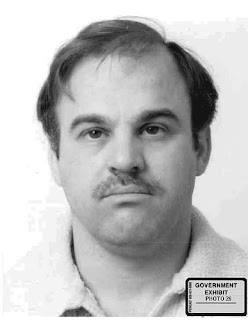
Friends of ours: Tony "The Ant" Spilotro, Nick Calabrese, Frank Calabrese Sr., James Marcello, John "Bananas" DiFronzo, Sam "Wings" Carlisi, Joe Ferriola, John Fecarotta, Jimmy LaPietra, Louis "The Mooch" Eboli, Louis Marino, William "Butch" Petrocelli, Joseph "Joey Doves" Aiuppa
Friends of mine: Michael Spilotro
Stepping into a suburban basement as his brother was wrestled to the floor, mobster Anthony "the Ant" Spilotro realized he had walked into a fatal trap and made a final plea. "He said, 'Can I say a prayer?' " mob turncoat Nicholas Calabrese, testifying Wednesday at the landmark Family Secrets trial, said he overheard the feared Outfit killer say.
The dramatic testimony was the first public account by an insider of one of the most infamous Outfit killings in Chicago history. The Spilotros had run afoul of mob bosses for bringing too much heat on the Outfit's lucrative Las Vegas arm, headed by Anthony Spilotro, Calabrese said. Days later the brothers' bodies, one on top of the other, were discovered buried in an Indiana cornfield.
In two full days on the witness stand, Calabrese has laid out many of the 14 murders that he says he personally took part in. He has implicated his brother, Frank Sr., who is on trial with four others, in many of the murders, but not the Spilotros' killings.
Nicholas Calabrese said he had already tackled Spilotro's brother, Michael, around the legs when he heard Anthony ask to say a prayer.
What happened next?, a prosecutor asked. "I didn't hear anymore," Calabrese said, still looking more like an average senior citizen than a hit man. He spoke calmly, almost in a monotone at times, and occasionally crossed a leg on the witness stand.
Calabrese said as many as 10 others joined in the 1986 fatal beating of the Spilotros, including defendant James Marcello, identified by authorities in recent years as the mob's top boss in Chicago.
In the months before the Spilotros were slain, a team of mob killers, Calabrese among them, had traveled to Las Vegas in hopes of killing the brothers there, Nicholas Calabrese said. The hit men tracked the brothers' movements, following Anthony Spilotro to his lawyer's office, located near the federal building in Las Vegas, and to the cul-de-sac on which his home was located.
At first, the plan was to use explosives or a silencer-equipped Uzi submachine gun, Calabrese said, but those attempts never panned out. Instead, he said, the Spilotro brothers were lured back to Chicago under the ruse that they would be promoted—Michael into the mob's inner circle as a "made" member and Anthony as a "capo" or captain.
Calabrese said he was told by mob hit man John Fecarotta that Anthony Spilotro had been targeted for having an affair with the wife of a Chicago bookmaker. Spilotro was also rumored to be involved in moving drugs with a motorcycle gang, he said.
Calabrese testified he had just returned to Chicago from a mob hit on an informant in Phoenix when he learned he had been tabbed to be part of the team to take out the Spilotros. He immediately told older brother Frank Sr., who has been charged in as many as 13 gangland slayings. "He got upset and said, 'Why didn't they ask me? I wanted to be there,' " Nicholas Calabrese said of his brother.
Calabrese said he was told to wait at a shopping center on 22nd Street, west of Illinois Highway 83 in DuPage County, to be taken to the killing site. With him were Fecarotta and mob boss Jimmy LaPietra, a leader of the 26th Street mob crew that included the two Calabreses as members.
Marcello picked the men up in a "fancy blue van," Calabrese said. It was early in the afternoon on a Saturday, June 14, 1986, he said. Calabrese said the men drove north to a Bensenville subdivision, turning left before reaching Irving Park Road. There were homes and brick walls, he said he remembered, and one with a garage door up. They entered and were greeted by a group of top mob leaders—John "Bananas" DiFronzo, Sam "Wings" Carlisi and Joe Ferriola, he said.
Carlisi commented about Calabrese's tan from his Phoenix foray and made a passing remark about how much money Fecarotta had burned through there. Fecarotta dashed into a bathroom, perhaps fearful the bosses had it in for him, Calabrese said. "He come out, he was pale," Calabrese said. "I figured he thinks this is for him."
But it turned out Fecarotta wasn't yet a marked man. He would be killed three months later after botching the Spilotros' burial.
Joining the others in the basement were mob figures Louis "The Mooch" Eboli and Louis Marino as well as three individuals Calabrese did not recognize. All of them were wearing gloves, he said.
It was only 30 minutes before the Spilotros arrived upstairs.
"I remember hearing talking and somebody coming in and saying 'hello' to everybody," said Calabrese, exhaling audibly on the stand. "I'm wound up because I'm tense. I'm focusing on what I'm gonna do."
Marcello had no noticeable reaction as courtroom spectators hung on to Calabrese's every word.
First down the stairs was Michael Spilotro, Calabrese said.
"I said, 'How you doing Mike?' because I knew him," Calabrese said. Then Michael took a few steps toward Marino and the others, Calabrese told jurors. "I dove and grabbed his legs," he said. "I noticed right away that Louis the Mooch had a rope around his neck."
It was then, Calabrese said, that he heard Anthony Spilotro behind him, asking for a final moment with God.
Calabrese said he handed DiFronzo a pocket-size .22-caliber revolver taken from Michael Spilotro's body. Michael's Lincoln was moved to a nearby motel, he said.
Calabrese said he wiped up a small spot of blood from where Anthony had fallen and had been beaten. He had nothing to do with disposing of the bodies, he said.
After the killings, Calabrese said he went for a cup of coffee.
The testimony came after Calabrese had described his rise in the Chicago mob—from helping his brother run street gambling to his initiation as a "made" member and sometimes bumbling hit man. He continued to weave a vivid tale of Outfit life, with all its customs and characters on display.
Assistant U.S. Atty. Mitchell Mars walked him through a series of murders, including that of mobster William "Butch" Petrocelli and Hinsdale businessman Michael Cagnoni.
Petrocelli was killed for being "too flamboyant," Calabrese said. In 1980 the mob figure planned a downtown party with hookers on which his bosses frowned.
Calabrese said he, his brother and other crew members decided to use a remote-controlled bomb to kill Cagnoni after finding his movements too unpredictable for more old-fashioned methods.
Cagnoni, a trucking executive, died in June 1981 when a bomb under the seat of his Mercedes-Benz auto was detonated as he drove on a ramp from Ogden Avenue to the Tri-State Tollway (Interstate Highway 294), scattering body parts and metal pieces across the highway. The crew practiced using remote firing devices and blasting caps to determine how close they would need to be to set off the explosives, he said.
Calabrese acknowledged he was the gunman who shot Emil Vaci in Phoenix in 1986. Fecarotta was supposed to be involved, too, he said, but had headed to Las Vegas after becoming skittish.
Calabrese also described for jurors his own "making" ceremony, saying he he was driven to a restaurant on Roosevelt Road and led before a table of Outfit kingpins, including Joseph "Joey Doves" Aiuppa.
Spread out before him were a gun, a knife and a candle, he said. Aiuppa threw a burning religious card onto the palm of his hand, Calabrese said, and had him repeat the same phrase. "If I give up my brothers," he said, "may I burn in hell like this holy picture?"
Thanks to Jeff Coen
Mob Archive of Current and Historical Mafia, Organized Crime & Gangster News. Primary focus on Chicago, but will include some national, especially New York, as well as global reports, along with the evolution of organized crime throughout society today. Topics will also include impact on pop culture through book reviews, movies, games and general interest.
Saturday, July 21, 2007
Wednesday, July 18, 2007
Boss of Los Angeles Mob?
Friends of ours: Peter "Shakes" Milano
A long time reader asked me if I was familiar with the current Boss of the Hollywood mafia since Shakes Milano is in semi-retirement. I have discussed it with a few buddies, with some still clinging to Shakes as the Boss and others believing that not to be the case. I am not a big time follower of L.A., so I thought I would open the question to others? Drop me a line if you have a theory.
The Mad Ones to Hit Tinseltown
Friends of ours: Joey "Crazy Joe" Gallo, Albert "Kid Blast" Gallo, Larry Gallo
The Weinstein Co. has optioned film rights to develop and produce Tom Folsom's nonfiction Mafia book, "The Mad Ones: Crazy Joe and the Revolution at the Edge of the Underworld," with its Weinstein Books division nabbing North American publication rights.
"Mad Ones," set to hit U.S. bookshelves in 2009, chronicles the lives of the Gallo brothers, three infamous 1960s-era Brooklyn gangsters: Joey "Crazy Joe" Gallo, Albert "Kid Blast" Gallo and Larry Gallo. It traces their attempt to overthrow the local Mafia and Crazy Joe's travels in the Greenwich Village counterculture scene.
The Weinstein Co. also acquired TV and home video rights to the project in the pre-emptive deal.
Folsom's credits include writing and directing documentaries for A&E and Showtime. He co-authored Nicky Barnes' autobiographical mob book, "Mr. Untouchable
: The Rise, Fall and Resurrection of Heroin's Teflon Don," and was an editor at Rugged Land Books.
The Weinstein Co. has optioned film rights to develop and produce Tom Folsom's nonfiction Mafia book, "The Mad Ones: Crazy Joe and the Revolution at the Edge of the Underworld," with its Weinstein Books division nabbing North American publication rights.
"Mad Ones," set to hit U.S. bookshelves in 2009, chronicles the lives of the Gallo brothers, three infamous 1960s-era Brooklyn gangsters: Joey "Crazy Joe" Gallo, Albert "Kid Blast" Gallo and Larry Gallo. It traces their attempt to overthrow the local Mafia and Crazy Joe's travels in the Greenwich Village counterculture scene.
The Weinstein Co. also acquired TV and home video rights to the project in the pre-emptive deal.
Folsom's credits include writing and directing documentaries for A&E and Showtime. He co-authored Nicky Barnes' autobiographical mob book, "Mr. Untouchable
Bombings and Killings Detailed by Nick Calabrese
Friends of ours: Frank Calabrese Sr., Nicholas Calabrese, James "Little Jimmy" Marcello, Joseph "Joey the Clown" Lombardo, Michael "Hambone" Albergo, Ronald Jarrett
Friends of mine: Michael Tadin, Michael "Mickey" Gurgone
When Frank Calabrese Sr. told his brother, Nicholas, that they were going to have to find a place to dig a hole to put a body in, Nicholas Calabrese believed his brother was joking.
When they found the spot, a factory that was being built a few blocks away from White Sox park, with no workers around over the weekend, Nicholas Calabrese figured it was only a test.
"We left and went and got a shovel and one or two bags of lime," Nicholas Calabrese told jurors this afternoon in the Family Secrets mob trial as he described the first of several mob murders he allegedly committed with his brother.
Nicholas Calabrese is the star witness of the trial. He has already pleaded guilty in the case and admitted to killing at least 14 people. He is testifying against his brother, Frank Calabrese Sr., a reputed mob hitman, as well as alleged Chicago mob bosses James "Little Jimmy" Marcello and Joseph "Joey the Clown" Lombardo, and two other men in the Family Secrets case.
Nicholas Calabrese described to the jury his first Outfit murder with his brother, which was in August 1970. Nicholas Calabrese figured the hole digging was "a test to see if I had the courage to do something like this, the nerve."
Nicholas Calabrese didn't even know the name of the man to be killed, only that he could testify against his brother, Frank Calabrese Sr., and cause him problems. Nicholas Calabrese had not a clue that the victim was Michael "Hambone" Albergo, a juice loan collector for Calabrese Sr.
Calabrese Sr.'s close friend, the late Ronald Jarrett, knew Albergo and lured him into a four-door Chevy that Jarrett had stolen to be used in the murder. Then Jarrett picked up the Calabrese brothers, who sat in back, while Albergo sat in front.
It was a Sunday, and Jarrett drove out to the factory construction site. Jarrett grabbed one of the victim's arms. Nicholas Calabrese grabbed the other.
"My brother put a rope around his neck and started strangling him," Nicholas Calabrese said, pausing at times during his testimony to collect himself. "Did he kill him?" Assistant U.S. Attorney Mitchell Mars asked. "Yes," Nicholas Calabrese said.
Later, Frank Calabrese Sr. allegedly cut the dead man's throat just to make sure he was dead, Nicholas Calabrese testified.
After removing the dead man's pants, the victim was thrown in the hole at the construction site. The brothers threw in two bags of lime and started filling the hole. "At this point, I wet my pants I was so scared," Nicholas Calabrese said.
Later on, Frank Calabrese Sr., who was fond of talking in code, told his brother to never mention the murder by name. Always refer to the slaying as "It," Frank Calabrese Sr. allegedly said. "'It' could be anything," Nicholas Calabrese explained.
Earlier on in the trial, Nicholas Calabrese testified that in the 1980s he and his brother took part in bombing Marina Trucking -- owned by Michael Tadin, a longtime supporter of Mayor Daley -- the Drury Lane Theatre in Oakbrook Terrace and a well-known mobster hangout, Horwath's Restaurant in Elmwood Park.
Nicholas Calabrese said he took part in the bombing of Marina Trucking and another trucking company on the South Side in the early to mid 1980s. He bombed the Drury Lane Theatre before it was opened and was with a group of men who planned the bombing of two restaurants, including Horwath's.
Calabrese testified he wasn't told why he was doing the bombings. But he told jurors how the Outfit would use bombings to intimidate and extort business people.
Tadin had no comment when reached this afternoon. Marina Trucking has previously employed men associated with organized crime, including the late Ronald Jarrett, whose name has come up frequently during the Family Secrets trial as an Outfit killer and juice loan collector, and Michael "Mickey" Gurgone, a former Streets and Sanitation worker and convicted burglar. Both men are also from the Bridgeport neighborhood where Marina is based.
Nicholas Calabrese also described to jurors how his brother, Frank Sr., once lost track of $400,000 to $500,000 of his own money in the 1980s. Frank Calabrese Sr. had about $1.6 million in cash in several safety deposit boxes in banks throughout the Chicago area but forgot about one of them, Nicholas Calabrese testified. Frank Calabrese Sr. once had a late-night meeting with Nicholas Calabrese where Frank Calabrese Sr. told him, "There's a lot of money missing."
"I says, 'What's that got to do with me?'" Nicholas Calabrese testified. Nicholas Calabrese reminded his brother that Frank Sr. had two safety deposit boxes at one of the banks.
Thanks to Steve Warmbir
Friends of mine: Michael Tadin, Michael "Mickey" Gurgone
When Frank Calabrese Sr. told his brother, Nicholas, that they were going to have to find a place to dig a hole to put a body in, Nicholas Calabrese believed his brother was joking.
When they found the spot, a factory that was being built a few blocks away from White Sox park, with no workers around over the weekend, Nicholas Calabrese figured it was only a test.
"We left and went and got a shovel and one or two bags of lime," Nicholas Calabrese told jurors this afternoon in the Family Secrets mob trial as he described the first of several mob murders he allegedly committed with his brother.
Nicholas Calabrese is the star witness of the trial. He has already pleaded guilty in the case and admitted to killing at least 14 people. He is testifying against his brother, Frank Calabrese Sr., a reputed mob hitman, as well as alleged Chicago mob bosses James "Little Jimmy" Marcello and Joseph "Joey the Clown" Lombardo, and two other men in the Family Secrets case.
Nicholas Calabrese described to the jury his first Outfit murder with his brother, which was in August 1970. Nicholas Calabrese figured the hole digging was "a test to see if I had the courage to do something like this, the nerve."
Nicholas Calabrese didn't even know the name of the man to be killed, only that he could testify against his brother, Frank Calabrese Sr., and cause him problems. Nicholas Calabrese had not a clue that the victim was Michael "Hambone" Albergo, a juice loan collector for Calabrese Sr.
Calabrese Sr.'s close friend, the late Ronald Jarrett, knew Albergo and lured him into a four-door Chevy that Jarrett had stolen to be used in the murder. Then Jarrett picked up the Calabrese brothers, who sat in back, while Albergo sat in front.
It was a Sunday, and Jarrett drove out to the factory construction site. Jarrett grabbed one of the victim's arms. Nicholas Calabrese grabbed the other.
"My brother put a rope around his neck and started strangling him," Nicholas Calabrese said, pausing at times during his testimony to collect himself. "Did he kill him?" Assistant U.S. Attorney Mitchell Mars asked. "Yes," Nicholas Calabrese said.
Later, Frank Calabrese Sr. allegedly cut the dead man's throat just to make sure he was dead, Nicholas Calabrese testified.
After removing the dead man's pants, the victim was thrown in the hole at the construction site. The brothers threw in two bags of lime and started filling the hole. "At this point, I wet my pants I was so scared," Nicholas Calabrese said.
Later on, Frank Calabrese Sr., who was fond of talking in code, told his brother to never mention the murder by name. Always refer to the slaying as "It," Frank Calabrese Sr. allegedly said. "'It' could be anything," Nicholas Calabrese explained.
Earlier on in the trial, Nicholas Calabrese testified that in the 1980s he and his brother took part in bombing Marina Trucking -- owned by Michael Tadin, a longtime supporter of Mayor Daley -- the Drury Lane Theatre in Oakbrook Terrace and a well-known mobster hangout, Horwath's Restaurant in Elmwood Park.
Nicholas Calabrese said he took part in the bombing of Marina Trucking and another trucking company on the South Side in the early to mid 1980s. He bombed the Drury Lane Theatre before it was opened and was with a group of men who planned the bombing of two restaurants, including Horwath's.
Calabrese testified he wasn't told why he was doing the bombings. But he told jurors how the Outfit would use bombings to intimidate and extort business people.
Tadin had no comment when reached this afternoon. Marina Trucking has previously employed men associated with organized crime, including the late Ronald Jarrett, whose name has come up frequently during the Family Secrets trial as an Outfit killer and juice loan collector, and Michael "Mickey" Gurgone, a former Streets and Sanitation worker and convicted burglar. Both men are also from the Bridgeport neighborhood where Marina is based.
Nicholas Calabrese also described to jurors how his brother, Frank Sr., once lost track of $400,000 to $500,000 of his own money in the 1980s. Frank Calabrese Sr. had about $1.6 million in cash in several safety deposit boxes in banks throughout the Chicago area but forgot about one of them, Nicholas Calabrese testified. Frank Calabrese Sr. once had a late-night meeting with Nicholas Calabrese where Frank Calabrese Sr. told him, "There's a lot of money missing."
"I says, 'What's that got to do with me?'" Nicholas Calabrese testified. Nicholas Calabrese reminded his brother that Frank Sr. had two safety deposit boxes at one of the banks.
Thanks to Steve Warmbir
on
7/18/2007
| Reactions: |
The Stench of Mob Money
Friends of ours: Nicholas Calabrese
Admitted mobster Nicholas Calabrese says he was desperate to find hiding places for his gambling and extortion money. So he says he stuffed as much as $250,000 into a metal box and buried it at Williams Bay, Wisconsin.
Calabrese testified today at the trial of 5 alleged members of the Chicago mob, and he told of the mess he found when he dug up the money six months later.
Calabrese says the cash was mildewed and stinky. He says they tried to use cologne on it but that just made the odor worse.
Calabrese says the mobsters eventually got rid of the smelly money by lending it to customers of their loan-sharking business at rates of 5% a week.
Admitted mobster Nicholas Calabrese says he was desperate to find hiding places for his gambling and extortion money. So he says he stuffed as much as $250,000 into a metal box and buried it at Williams Bay, Wisconsin.
Calabrese testified today at the trial of 5 alleged members of the Chicago mob, and he told of the mess he found when he dug up the money six months later.
Calabrese says the cash was mildewed and stinky. He says they tried to use cologne on it but that just made the odor worse.
Calabrese says the mobsters eventually got rid of the smelly money by lending it to customers of their loan-sharking business at rates of 5% a week.
Mob Brother Vs. Mob Brother
Friends of ours: Nicholas Calabrese, Frank Calabrese Sr., Paul "the Indian" Schiro, James Marcello, John Fecarotta, John "Johnny Apes" Monteleone, Jimmy LaPietra, Joey "the Clown" Lombardo, Joseph "Joey Doves" Aiuppa, Jackie Cerone, William "Butch" Petrocelli, Michael Talarico, Angelo LaPietra, Richard "Richie the Rat" Mara
The man whose testimony is expected to lift the shadow on some of the Chicago Outfit's most notorious murders over the last three decades looked harmless enough. Nicholas Calabrese took the witness stand Monday wearing a gray sweatsuit and rounded eyeglasses. With his white hair neatly parted, he looked more like a doughy banker in his pajamas than a "made" member of the mob who has admitted to taking part in 14 gangland killings.
As one of the highest-ranking turncoats in Chicago's inglorious mob history, the testimony of Calabrese, 64, promises to be the pivotal moment of the Family Secrets trial, providing first-hand accounts of the Outfit's secret induction ceremony and a long list of hits. He is expected to spend several weeks testifying against his brother, Frank Calabrese Sr., and four co-defendants.
For Frank Calabrese Sr., the testimony represents a second nightmare come true. Last week his son, Frank Jr., testified against him as federal prosecutors played a series of undercover tapes that the son had secretly recorded of private prison conversations with his father. But Nicholas Calabrese's testimony could be far more damaging. He also secretly recorded his brother and has more intimate knowledge of his brother's alleged wrongdoing as the two worked side-by-side for the mob as reputed made members.
As his testimony was about to begin late Monday afternoon, Nicholas Calabrese stared ahead at a darkened computer screen placed on the witness stand. His brother sat just yards away. Assistant U.S. Atty. Mitchell Mars asked whether Nicholas Calabrese was familiar with an organization known as the Outfit, and whether he was a member.
"Yes, I was," Calabrese said.
Mars asked whether Calabrese had committed a murder with reputed mob boss James Marcello, one of the defendants on trial, as well as a murder in Phoenix with co-defendant Paul "the Indian" Schiro and yet another murder with his brother.
"Yes," was the answer each time, in a matter-of-fact tone.
With that, Frank Calabrese Sr., who during an earlier break Monday leaned back in his chair and appeared to take a catnap, pitched forward at the defense table and straightened his glasses.
Some of the murders were to make an example of someone, Nicholas Calabrese said. Others were to protect the Outfit from anyone who might talk to authorities.
As part of his deal for cooperating, Nicholas Calabrese said, he understands that he won't be prosecuted for any of the 14 homicides as long as he testifies truthfully. In addition, the government will recommend something less than the life in prison he could have faced if he had been convicted of even one murder. Ultimately, U.S. District Judge James Zagel, who is presiding over the trial, will impose his sentence. "When I'm on the stand, I can't lie," Calabrese told jurors, most of whom took notes throughout his first hour of testimony, which came as the trial was ending for the day.
Calabrese did not look in his brother's direction as he answered questions. Frank Calabrese Sr. chuckled with a hand to his mouth at some points. At other times, he leaned over and looked animated as he whispered to his lawyer.
Nicholas Calabrese, pausing to clear his throat and sip from a cup, said his association with the mob dated to 1969. He began cooperating in 2002, he said, after being confronted with DNA evidence on a bloody glove that linked him to the 1986 killing of mob hit-man John Fecarotta.
Calabrese said he was joined in that murder by his brother and reputed mob figure John "Johnny Apes" Monteleone after Jimmy LaPietra, the reputed crew "capo" or captain at the time, gave his approval. Federal prosecutors have told jurors the Chicago mob is a decades-old criminal enterprise that protected itself with murder when necessary.
Calabrese said he worked for his brother in the mob's 26th Street, or Chinatown, crew. There were other crews as well , he said, including Rush Street, Melrose Park, Chicago Heights and Grand Avenue, which he said was led by co-defendant Joey "the Clown" Lombardo.
At the top of the Outfit hierarchy in the 1970s was the boss, Joseph "Joey Doves" Aiuppa, and the underboss, Jackie Cerone, known as "One and Two," Calabrese said.
Every murder had to be cleared by higher-ups, he said, and disputes were settled in "sit-downs" with bosses. For example, he said his brother once had a dispute with mobster William "Butch" Petrocelli and Aiuppa himself had to become involved.
"He said, 'If you guys can't straighten it out, I'll straighten it out,'" said Calabrese, quoting Auippa. Asked by Mars what that meant, Calabrese answered, "They'd probably both get killed" if they didn't take care of the dispute themselves. At one point in the 1970s, a sports-gambling operation pulled in $500,000 to $750,000 a year for his brother, said Nicholas Calabrese, who told jurors that he did the paperwork for the crew. Some of the profits were passed up to LaPietra, he said.
Even as the trial was ending for the day, Nicholas Calabrese avoided looking at his brother. He stood facing the jury box as jurors left the courtroom, his back to the defendants until court security led him away. Frank Calabrese continued to laugh, shaking hands with his attorney, as he walked out to a lockup by the courtroom. He remains in custody..
In earlier testimony Monday, a 55-year-old Bridgeport native with swept-back, salt-and-pepper hair, testifying with immunity from prosecution, told jurors he formerly ran surveillances for the Outfit.
Michael Talarico, admitting he still works as a bookie, recalled how he once left a dead rat, a rope strung around its neck, at the office of someone who apparently ran afoul of his uncle, reputed mob boss Angelo LaPietra.
He said he left the rat on instructions from LaPietra. "He never gave me a reason," Talarico said. Assistant U.S. Atty. Markus Funk asked whether Talarico had gotten the rat at a pet store. "Yeah, I believe so," Talarico said.
LaPietra put him in business with the Calabrese brothers, Talarico said, and he made payments for running his gambling operation and also gave out juice loans on their behalf.
On cross-examination, he said Nicholas Calabrese once cut off the head of a puppy and placed it on someone's car, a gesture that also went unexplained.
Also testifying Monday was Richard "Richie the Rat" Mara, who told jurors he was an agent for jockeys as well as a Teamster at McCormick Place before pulling off burglaries and armed robberies for Frank Calabrese's crew.
He said he once saw Frank Calabrese Sr. "beat the [expletive]" out of someone making unauthorized juice loans.
Thanks to Jeff Coen
The man whose testimony is expected to lift the shadow on some of the Chicago Outfit's most notorious murders over the last three decades looked harmless enough. Nicholas Calabrese took the witness stand Monday wearing a gray sweatsuit and rounded eyeglasses. With his white hair neatly parted, he looked more like a doughy banker in his pajamas than a "made" member of the mob who has admitted to taking part in 14 gangland killings.
As one of the highest-ranking turncoats in Chicago's inglorious mob history, the testimony of Calabrese, 64, promises to be the pivotal moment of the Family Secrets trial, providing first-hand accounts of the Outfit's secret induction ceremony and a long list of hits. He is expected to spend several weeks testifying against his brother, Frank Calabrese Sr., and four co-defendants.
For Frank Calabrese Sr., the testimony represents a second nightmare come true. Last week his son, Frank Jr., testified against him as federal prosecutors played a series of undercover tapes that the son had secretly recorded of private prison conversations with his father. But Nicholas Calabrese's testimony could be far more damaging. He also secretly recorded his brother and has more intimate knowledge of his brother's alleged wrongdoing as the two worked side-by-side for the mob as reputed made members.
As his testimony was about to begin late Monday afternoon, Nicholas Calabrese stared ahead at a darkened computer screen placed on the witness stand. His brother sat just yards away. Assistant U.S. Atty. Mitchell Mars asked whether Nicholas Calabrese was familiar with an organization known as the Outfit, and whether he was a member.
"Yes, I was," Calabrese said.
Mars asked whether Calabrese had committed a murder with reputed mob boss James Marcello, one of the defendants on trial, as well as a murder in Phoenix with co-defendant Paul "the Indian" Schiro and yet another murder with his brother.
"Yes," was the answer each time, in a matter-of-fact tone.
With that, Frank Calabrese Sr., who during an earlier break Monday leaned back in his chair and appeared to take a catnap, pitched forward at the defense table and straightened his glasses.
Some of the murders were to make an example of someone, Nicholas Calabrese said. Others were to protect the Outfit from anyone who might talk to authorities.
As part of his deal for cooperating, Nicholas Calabrese said, he understands that he won't be prosecuted for any of the 14 homicides as long as he testifies truthfully. In addition, the government will recommend something less than the life in prison he could have faced if he had been convicted of even one murder. Ultimately, U.S. District Judge James Zagel, who is presiding over the trial, will impose his sentence. "When I'm on the stand, I can't lie," Calabrese told jurors, most of whom took notes throughout his first hour of testimony, which came as the trial was ending for the day.
Calabrese did not look in his brother's direction as he answered questions. Frank Calabrese Sr. chuckled with a hand to his mouth at some points. At other times, he leaned over and looked animated as he whispered to his lawyer.
Nicholas Calabrese, pausing to clear his throat and sip from a cup, said his association with the mob dated to 1969. He began cooperating in 2002, he said, after being confronted with DNA evidence on a bloody glove that linked him to the 1986 killing of mob hit-man John Fecarotta.
Calabrese said he was joined in that murder by his brother and reputed mob figure John "Johnny Apes" Monteleone after Jimmy LaPietra, the reputed crew "capo" or captain at the time, gave his approval. Federal prosecutors have told jurors the Chicago mob is a decades-old criminal enterprise that protected itself with murder when necessary.
Calabrese said he worked for his brother in the mob's 26th Street, or Chinatown, crew. There were other crews as well , he said, including Rush Street, Melrose Park, Chicago Heights and Grand Avenue, which he said was led by co-defendant Joey "the Clown" Lombardo.
At the top of the Outfit hierarchy in the 1970s was the boss, Joseph "Joey Doves" Aiuppa, and the underboss, Jackie Cerone, known as "One and Two," Calabrese said.
Every murder had to be cleared by higher-ups, he said, and disputes were settled in "sit-downs" with bosses. For example, he said his brother once had a dispute with mobster William "Butch" Petrocelli and Aiuppa himself had to become involved.
"He said, 'If you guys can't straighten it out, I'll straighten it out,'" said Calabrese, quoting Auippa. Asked by Mars what that meant, Calabrese answered, "They'd probably both get killed" if they didn't take care of the dispute themselves. At one point in the 1970s, a sports-gambling operation pulled in $500,000 to $750,000 a year for his brother, said Nicholas Calabrese, who told jurors that he did the paperwork for the crew. Some of the profits were passed up to LaPietra, he said.
Even as the trial was ending for the day, Nicholas Calabrese avoided looking at his brother. He stood facing the jury box as jurors left the courtroom, his back to the defendants until court security led him away. Frank Calabrese continued to laugh, shaking hands with his attorney, as he walked out to a lockup by the courtroom. He remains in custody..
In earlier testimony Monday, a 55-year-old Bridgeport native with swept-back, salt-and-pepper hair, testifying with immunity from prosecution, told jurors he formerly ran surveillances for the Outfit.
Michael Talarico, admitting he still works as a bookie, recalled how he once left a dead rat, a rope strung around its neck, at the office of someone who apparently ran afoul of his uncle, reputed mob boss Angelo LaPietra.
He said he left the rat on instructions from LaPietra. "He never gave me a reason," Talarico said. Assistant U.S. Atty. Markus Funk asked whether Talarico had gotten the rat at a pet store. "Yeah, I believe so," Talarico said.
LaPietra put him in business with the Calabrese brothers, Talarico said, and he made payments for running his gambling operation and also gave out juice loans on their behalf.
On cross-examination, he said Nicholas Calabrese once cut off the head of a puppy and placed it on someone's car, a gesture that also went unexplained.
Also testifying Monday was Richard "Richie the Rat" Mara, who told jurors he was an agent for jockeys as well as a Teamster at McCormick Place before pulling off burglaries and armed robberies for Frank Calabrese's crew.
He said he once saw Frank Calabrese Sr. "beat the [expletive]" out of someone making unauthorized juice loans.
Thanks to Jeff Coen
Mob Hitman on Witness Stand
Friends of ours: Nick Calabrese, Frank Calabrese Sr., John Fecarotta, James "Litte Jimmy" Marcello
An admitted hitman for the Chicago mob is being let off the hook for several gangland murders in exchange for his testimony in the Operation Family Secrets trial. Nick Calabrese, the former hitman and now star witness in the case, began his testimony Monday.
Outfit killer Nick Calabrese says he and his brother Frank Senior killed mob enforcer John Fecarotta back in 1986. Fecarotta, a hitman himself, had botched a gangland assignment and was given the ultimate demotion.
Homicide detectives found a bloody glove near Fecarotta's corpse. It wasn't until new DNA technology, in 2002, that investigators matched the bloody glove to Nick Calabrese. Faced with that evidence, Nick Calabrese violated his outfit oath of allegiance and betrayed his own brother, Frank Senior, working undercover against La Cosa Nostra, the organization in which they both were blood-made members.
Monday, for the first time, brother Nick was on the witness stand testifying against brother Frank. "We're not expecting to see anything other than what he's gonna tell us. We don't know what he's gonna tell us," said Joe Lopez, Frank Calabrese Senior's lawyer.
Nick's first hour of testimony implicated his brother in murders, juice loan rackets and outfit decision making. Said Nick Calabrese: "If you got an order to go kill somebody, you'd have to do it." He also testified that committed mob murders with defendant James "Little Jimmy" Marcello and is expected to provide details when retaking the stand Tuesday.
In exchange for his testimony, Nick Calabrese will not be prosecuted in state court for the Fecarotta murder or any other killings. Nick is off the hook. According to letters introduced Monday in court from state's attorneys in Cook, DuPage and Will counties, all have agreed not to prosecute Nick Calabrese.
He is still eligible for life in prison after pleading guilty to racketeering in Operation Family Secrets, but federal authorities will recommend a sentence far less than that for Nick Calabrese. That made this a deal Calabrese was unable to refuse.
Thanks to Chuck Goudie
An admitted hitman for the Chicago mob is being let off the hook for several gangland murders in exchange for his testimony in the Operation Family Secrets trial. Nick Calabrese, the former hitman and now star witness in the case, began his testimony Monday.
Outfit killer Nick Calabrese says he and his brother Frank Senior killed mob enforcer John Fecarotta back in 1986. Fecarotta, a hitman himself, had botched a gangland assignment and was given the ultimate demotion.
Homicide detectives found a bloody glove near Fecarotta's corpse. It wasn't until new DNA technology, in 2002, that investigators matched the bloody glove to Nick Calabrese. Faced with that evidence, Nick Calabrese violated his outfit oath of allegiance and betrayed his own brother, Frank Senior, working undercover against La Cosa Nostra, the organization in which they both were blood-made members.
Monday, for the first time, brother Nick was on the witness stand testifying against brother Frank. "We're not expecting to see anything other than what he's gonna tell us. We don't know what he's gonna tell us," said Joe Lopez, Frank Calabrese Senior's lawyer.
Nick's first hour of testimony implicated his brother in murders, juice loan rackets and outfit decision making. Said Nick Calabrese: "If you got an order to go kill somebody, you'd have to do it." He also testified that committed mob murders with defendant James "Little Jimmy" Marcello and is expected to provide details when retaking the stand Tuesday.
In exchange for his testimony, Nick Calabrese will not be prosecuted in state court for the Fecarotta murder or any other killings. Nick is off the hook. According to letters introduced Monday in court from state's attorneys in Cook, DuPage and Will counties, all have agreed not to prosecute Nick Calabrese.
He is still eligible for life in prison after pleading guilty to racketeering in Operation Family Secrets, but federal authorities will recommend a sentence far less than that for Nick Calabrese. That made this a deal Calabrese was unable to refuse.
Thanks to Chuck Goudie
Mafia Scam Profits from US War on Terror
Friends of mine: Mario Figueroa
More than a dozen Ulster business people have been caught up in a multi-million pound scam that targeted British and Irish investors hoping to make money from the US war on terror, the Belfast Telegraph can reveal today.
The head of the scheme, New Jersey fraudster Mario Figueroa, declared bankruptcy this month after living it up at the best Belfast hotels, where he boasted about his mansions and luxury yachts while luring people into the scheme.
Victims include the managing director of a Lisburn engineering company, a director of a Londonderry property company, the owner of a Strabane garden centre and the owner of a Belfast electrical shop.
The FBI suspects Mafia involvement in the scheme, which employed 30 salesmen working from central New Jersey and took in over $50m.
Figueroa admitted travelling many times to London, Dublin and Belfast to entice investors and based his business solely on UK and Irish investors. The defence companies he invested in were supposed to be major suppliers of Tomahawk cruise missiles and armament parts to be used in Afghanistan and Iraq. In reality, some were little more than shell companies designed to lure investors.
Figueroa led a lavish lifestyle, buying a $2m house, a Mercedes Benz sports car and a 62-foot yacht called Private Enterprise, all of which have now been seized by the New Jersey Attorney General's office.
One investor from the province, Frank Sumner, owner of the Strabane Garden Centre, was one of the few investors to get off lightly, losing about £6,000 to the scheme. Mr Sumner said that the Clover group had phoned him at work and promised he could make vast sums from their investment scheme. He recalled that Figueroa told him that he was coming to Belfast to meet businessmen who were prepared to put large sums of money into the scheme. "He didn't bother coming to see me, I was just small fry compared to some of the people he was looking for," Sumner said. Mr Sumner said he had invested in a defence contractor called Invatech, which the federal prosecutors in New Jersey have identified as one of three " poorly performing" companies into which victims' money was placed.
In a criminal complaint lodged in court, prosecutors say that investment money from one defence company, JCM, was used to pay off irate Invatech investors, while telling them that this money was "profit" from their investment. Many Invatech investors were so impressed they poured hundreds of thousands of dollars more into the scheme.
Sumner said that he hoped that a "slimeball" like Mario Figueroa be brought to justice "for the sake of people that have lost a lot" .
"I don't care if I don't get anything back," he said.
Figueroa has already pleaded guilty to racketeering and money laundering and is due for sentencing in September. He is currently working as a Manhattan mortgage broker, earning $16,000 a month.
According to court records, there are at least 13 Northern Ireland investors so far identified, many of them directors of companies involved in property, engineering and electronics.
They include Edward Nicell, director of Cara Development Ltd, a property investment company in Derleen Park in Derry; David Neil of Express Distribution Services in Craigavon, and Leslie Millar, the managing director of Rocklyn Engineering in Lisburn.
Other investors include Rufus McClelland of Calverts Tavern in Armagh city; Russell Kelly of Beechfield Court in Coleraine; Brian Caldwell of Kingsgate Street, Coleraine; Robert McClurg of Saintfield Road, Ballynahinch; Trevor Calderwood, with an address listed as "Unit 5" in Ballymena and Michael Loughran of Churchtown Road in Cookstown.
At least three UK investors lost over $1m each and have hired a New Jersey attorney to win their money back. Scotland Yard believes that there may be other UK and Irish investors who have not come forward because of fear of tax implications.
One London investment company which is listed as a Figueroa creditor at least five times because of various investment schemes, was fined in 2005 for failure to prevent money laundering, the first company to be fined under UK anti-money laundering laws.
UK investors included a senior civil servant, Grant Ballantine, a consultant on state pension policy at the Government Actuary's Department. Mr Ballantine, who lost over $100,000, said that any money that is returned to investors would be a "drop in the bucket" compared to the amount invested.
Thanks to Sean O'Driscoll
More than a dozen Ulster business people have been caught up in a multi-million pound scam that targeted British and Irish investors hoping to make money from the US war on terror, the Belfast Telegraph can reveal today.
The head of the scheme, New Jersey fraudster Mario Figueroa, declared bankruptcy this month after living it up at the best Belfast hotels, where he boasted about his mansions and luxury yachts while luring people into the scheme.
Victims include the managing director of a Lisburn engineering company, a director of a Londonderry property company, the owner of a Strabane garden centre and the owner of a Belfast electrical shop.
The FBI suspects Mafia involvement in the scheme, which employed 30 salesmen working from central New Jersey and took in over $50m.
Figueroa admitted travelling many times to London, Dublin and Belfast to entice investors and based his business solely on UK and Irish investors. The defence companies he invested in were supposed to be major suppliers of Tomahawk cruise missiles and armament parts to be used in Afghanistan and Iraq. In reality, some were little more than shell companies designed to lure investors.
Figueroa led a lavish lifestyle, buying a $2m house, a Mercedes Benz sports car and a 62-foot yacht called Private Enterprise, all of which have now been seized by the New Jersey Attorney General's office.
One investor from the province, Frank Sumner, owner of the Strabane Garden Centre, was one of the few investors to get off lightly, losing about £6,000 to the scheme. Mr Sumner said that the Clover group had phoned him at work and promised he could make vast sums from their investment scheme. He recalled that Figueroa told him that he was coming to Belfast to meet businessmen who were prepared to put large sums of money into the scheme. "He didn't bother coming to see me, I was just small fry compared to some of the people he was looking for," Sumner said. Mr Sumner said he had invested in a defence contractor called Invatech, which the federal prosecutors in New Jersey have identified as one of three " poorly performing" companies into which victims' money was placed.
In a criminal complaint lodged in court, prosecutors say that investment money from one defence company, JCM, was used to pay off irate Invatech investors, while telling them that this money was "profit" from their investment. Many Invatech investors were so impressed they poured hundreds of thousands of dollars more into the scheme.
Sumner said that he hoped that a "slimeball" like Mario Figueroa be brought to justice "for the sake of people that have lost a lot" .
"I don't care if I don't get anything back," he said.
Figueroa has already pleaded guilty to racketeering and money laundering and is due for sentencing in September. He is currently working as a Manhattan mortgage broker, earning $16,000 a month.
According to court records, there are at least 13 Northern Ireland investors so far identified, many of them directors of companies involved in property, engineering and electronics.
They include Edward Nicell, director of Cara Development Ltd, a property investment company in Derleen Park in Derry; David Neil of Express Distribution Services in Craigavon, and Leslie Millar, the managing director of Rocklyn Engineering in Lisburn.
Other investors include Rufus McClelland of Calverts Tavern in Armagh city; Russell Kelly of Beechfield Court in Coleraine; Brian Caldwell of Kingsgate Street, Coleraine; Robert McClurg of Saintfield Road, Ballynahinch; Trevor Calderwood, with an address listed as "Unit 5" in Ballymena and Michael Loughran of Churchtown Road in Cookstown.
At least three UK investors lost over $1m each and have hired a New Jersey attorney to win their money back. Scotland Yard believes that there may be other UK and Irish investors who have not come forward because of fear of tax implications.
One London investment company which is listed as a Figueroa creditor at least five times because of various investment schemes, was fined in 2005 for failure to prevent money laundering, the first company to be fined under UK anti-money laundering laws.
UK investors included a senior civil servant, Grant Ballantine, a consultant on state pension policy at the Government Actuary's Department. Mr Ballantine, who lost over $100,000, said that any money that is returned to investors would be a "drop in the bucket" compared to the amount invested.
Thanks to Sean O'Driscoll
The Darkness Descends on a Mobster
It’s not often that I come across a game that’s a must have.
I play a lot of games and many of them only generate interest for a short amount of time. You pick up a shiny new game, play it like there’s no tomorrow, and then quickly become bored with it and move on to another game.
With the exception of World of Warcraft, most of the games that I review go back to the shelf once my review has been written. The Darkness, by publisher 2K Games, is definitely not going back to the shelf.
The game is based upon Marc Silvestri’s comic book of the same name. You play a member of the mob who is double-crossed by the Mafia boss. You shoot your way through many goons in your attempt to escape but are eventually cornered in a situation that you will not escape from.
Just when it seems that there is no way out. you are “selected” by a demonic force that chooses to use you as its host. With the demonic powers at your disposal, you are quickly able to dispatch your enemies and survive. Now, you have to see how long you can live with this demonic force within you.
The game is graphically gorgeous and the character models are extremely detailed. The dialogue is superb and seems like it’s lifted right out of a Tarantino script or an episode of The Sopranos. Voice actors must have had a blast recording this game; they certainly did their jobs and they deliver a terrific performance.
This game is rated “M” for mature and there’s definitely a reason for that. First of all, the game’s dialogue is heavily influenced by mob-style movies, so the dialogue is littered with swearing. Secondly, your use of your demonic powers can be quite grotesque.
When manifesting The Darkness, you have two shadow tendrils that resemble demonic snakes at your disposal. Other than just looking cool, their other function is to allow you to feed on the hearts of your enemies. The tendrils tear the hearts out of fallen enemies and consume the heart right before your eyes. Gross? You betcha. Awesome? Definitely.
I have so many games to review that I don’t tend to fixate on one game for too long at a time. However, The Darkness is definitely being added to my collection. This game is just too damn good to not have available at the house.
Thanks to Rob Michael
I play a lot of games and many of them only generate interest for a short amount of time. You pick up a shiny new game, play it like there’s no tomorrow, and then quickly become bored with it and move on to another game.
With the exception of World of Warcraft, most of the games that I review go back to the shelf once my review has been written. The Darkness, by publisher 2K Games, is definitely not going back to the shelf.
The game is based upon Marc Silvestri’s comic book of the same name. You play a member of the mob who is double-crossed by the Mafia boss. You shoot your way through many goons in your attempt to escape but are eventually cornered in a situation that you will not escape from.
Just when it seems that there is no way out. you are “selected” by a demonic force that chooses to use you as its host. With the demonic powers at your disposal, you are quickly able to dispatch your enemies and survive. Now, you have to see how long you can live with this demonic force within you.
The game is graphically gorgeous and the character models are extremely detailed. The dialogue is superb and seems like it’s lifted right out of a Tarantino script or an episode of The Sopranos. Voice actors must have had a blast recording this game; they certainly did their jobs and they deliver a terrific performance.
This game is rated “M” for mature and there’s definitely a reason for that. First of all, the game’s dialogue is heavily influenced by mob-style movies, so the dialogue is littered with swearing. Secondly, your use of your demonic powers can be quite grotesque.
When manifesting The Darkness, you have two shadow tendrils that resemble demonic snakes at your disposal. Other than just looking cool, their other function is to allow you to feed on the hearts of your enemies. The tendrils tear the hearts out of fallen enemies and consume the heart right before your eyes. Gross? You betcha. Awesome? Definitely.
I have so many games to review that I don’t tend to fixate on one game for too long at a time. However, The Darkness is definitely being added to my collection. This game is just too damn good to not have available at the house.
Thanks to Rob Michael
Tuesday, July 17, 2007
Judge Imposes Gag Order at Family Secrets Mob Trial
The federal judge at the trial of five alleged members of Chicago's organized crime family on Friday imposed a gag order, saying it would "enhance my ability to conduct a fair trial."
Judge James B. Zagel's order bars attorneys "from making extrajudicial statements regarding the merits of this case that a reasonable person would believe could be publicly disseminated."
He said the order would help him to conduct a fair trial because it was likely any commentary on the merits would prejudice the jurors. Zagel said barring parties from making comments to the news media may limit coverage and "prevent these proceedings from taking on a carnival atmosphere."
The indictment in the case outlines a racketeering conspiracy by the mob that includes 18 murders, gambling, extortion and loan sharking. Charged are Frank Calabrese Sr., 69; Joseph (Joey the Clown) Lombardo, 78; James Marcello, 65; jewel thief Paul Schiro, 70, and retired Chicago police officer Anthony Doyle, 62.
Zagel said his order would apply only to commentary or opinions on the merits of the case and would not block lawyers from providing reporters with information about scheduling and other such matters.
Judge James B. Zagel's order bars attorneys "from making extrajudicial statements regarding the merits of this case that a reasonable person would believe could be publicly disseminated."
He said the order would help him to conduct a fair trial because it was likely any commentary on the merits would prejudice the jurors. Zagel said barring parties from making comments to the news media may limit coverage and "prevent these proceedings from taking on a carnival atmosphere."
The indictment in the case outlines a racketeering conspiracy by the mob that includes 18 murders, gambling, extortion and loan sharking. Charged are Frank Calabrese Sr., 69; Joseph (Joey the Clown) Lombardo, 78; James Marcello, 65; jewel thief Paul Schiro, 70, and retired Chicago police officer Anthony Doyle, 62.
Zagel said his order would apply only to commentary or opinions on the merits of the case and would not block lawyers from providing reporters with information about scheduling and other such matters.
Monday, July 16, 2007
Former Judge Faces 20 Years In Prison For Mafia Dealings
Friends of ours: Genovese Crime Family, Nicholas Gruttadauria
Friends of mind: David Gross
A former Nassau County judge pleaded guilty Friday to trying to launder more than $400,000 for members of the Genovese crime family.
David Gross, 45, admitted he agreed to try to launder the cash he knew was the result of a jewelry heist. What Gross did not know is that one of the men he was making the deal with was an undercover FBI agent.
Federal prosecutors said Gross planned to keep up to 20 percent of all cash he agreed to launder. He also agreed to try to sell more than $280,000 worth of stolen diamonds. "Sworn to do justice, a sitting judge violated his oath as well as the law when he partnered with a member of organized crime to launder proceeds of criminal activity," U.S. attorney Roslynn Mauskopf said.
Gross was first elected as a Nassau County judge in 1999. He was arrested in 2005 and suspended pending the outcome of the criminal case against him. The investigation began after the FBI developed leads stemming from raids on several mafia-run gambling houses on Long Island.
New York FBI Director Mark Mershon described Gross' criminal conduct as "the most egregious betrayals of the public trust."
Investigators said the former judge had teamed up with Nicholas Gruttadauria who they said is a member of the Genovese crime family. Gruttadauria has also pleaded guilty. FBI officials said the two men tried to use invoices from Freeport restaurant Cafe By The Sea to launder the money.
Gross faces 20 years in prison and a $250,000 fine.
Thanks to WNBC
Friends of mind: David Gross
A former Nassau County judge pleaded guilty Friday to trying to launder more than $400,000 for members of the Genovese crime family.
David Gross, 45, admitted he agreed to try to launder the cash he knew was the result of a jewelry heist. What Gross did not know is that one of the men he was making the deal with was an undercover FBI agent.
Federal prosecutors said Gross planned to keep up to 20 percent of all cash he agreed to launder. He also agreed to try to sell more than $280,000 worth of stolen diamonds. "Sworn to do justice, a sitting judge violated his oath as well as the law when he partnered with a member of organized crime to launder proceeds of criminal activity," U.S. attorney Roslynn Mauskopf said.
Gross was first elected as a Nassau County judge in 1999. He was arrested in 2005 and suspended pending the outcome of the criminal case against him. The investigation began after the FBI developed leads stemming from raids on several mafia-run gambling houses on Long Island.
New York FBI Director Mark Mershon described Gross' criminal conduct as "the most egregious betrayals of the public trust."
Investigators said the former judge had teamed up with Nicholas Gruttadauria who they said is a member of the Genovese crime family. Gruttadauria has also pleaded guilty. FBI officials said the two men tried to use invoices from Freeport restaurant Cafe By The Sea to launder the money.
Gross faces 20 years in prison and a $250,000 fine.
Thanks to WNBC
How the Mob Impacts Your Wallet
Despite the sensational charges - racketeering and 18 murders - the trial of five alleged Chicago mobsters isn't exactly capturing the public's attention.
"There's an awful lot of attitude that we don't have to worry about the Outfit anymore," said James Wagner, head of the Chicago Crime Commission and a former FBI agent who battled the mob in New York and Chicago.
The five defendants all say they're innocent. In addition, Joseph "The Clown" Lombardo Sr., Frank Calabrese Sr., James Marcello, Paul "The Indian" Schiro and Anthony Doyle are all in their 60s and 70s, and the murders are alleged to have happened decades ago.
That may lead people to think the mob is ancient history, Wagner said. But he and another former FBI agent say that's not true. And while it may seem distant and irrelevant to suburban residents, experts say there are many reasons for the public to care about the outcome of such trials and the health of the mob, Wagner said:
James Stolfe, the owner of the popular Connie's Pizza, recently testified that he was threatened by two goons in the 1980s to pay "street tax" so he could stay in business - or else. Stolfe said he ended up paying $100,000 upfront and then $1,000 a month to Calabrese Sr. until 2002, not so very long ago.
"That's one example (of how the mob is still operating), but there are ... any number of businesses out there who are facing the same problem," Wagner said. "In all of those businesses, that's (the cost) passed on to the consumer."
"We're all paying an extra tax to support the Outfit," he said.
The link between unions and the mob is long and storied. The loser, Wagner said, is the average working member who gets stuck with contracts of questionable benefit while mobsters live high on the hog.
One illustration of this is the federal takeover of the Laborers International Union of North America because of pervasive mob influence. After the national takeover, the feds drilled down to its grass roots, its membership organizations. In Chicago, that was the Construction and General Laborers' District Council.
"The rights of members of the union to control the affairs of the union have been systematically abused," wrote federal trustees in 1999 court filings. "Those union members who might have opposed this corrupt state of affairs have been intimidated into silence."
At the time, the national union was made up of 21 locals and 19,000 members. Shortly before the takeover, the union's president was Bruno Caruso, who was "at least" an associate of organized crime, the trustees of Laborers International alleged. The group's vice president was John "Pudgy" Matassa Jr., a made member of the mob, they further claimed.
Besides serving as a "Who's Who" of mob leadership, union bosses spent thousands in union money on luxury meals and the like, the union trustees alleged.
Despite the court action against it in 1999, the Outfit fought tooth and nail to keep some hold on the unions. The fight lasted until 2004, when the court case was closed, shortly after forcing out several people alleged to be abusing union funds. The list included Joseph Lombardo Jr., son of Joseph Lombardo Sr., currently on trial.
In the last decade, dozens of people were convicted of abusing Chicago's Hired Trucks program, with truck companies paying city officials kickbacks to be in the program or, in some cases, to get paid for little or no work.
Some of the companies had mob ties "and therefore made a bundle of money off the improper management of the program," Wagner said. "Certainly a healthy percentage were connected to organized crime."
Those corruption costs are on top of the tax dollars that cover the labor and expenses of the FBI and U.S. attorney's office as they investigate the mob.
Gambling remains the life-blood of the mob, said Wagner and Peter Wacks, a former Chicago FBI agent who fought the mob for decades. "It's always been a big money-maker for them," Wacks said.
That remains true today. Along with the five men on trial now, numerous defendants pleaded guilty before the trial began to running a video poker ring until at least as late as 2003. "They've advanced, basically, like the rest of society has: electronically," Wacks said.
Another defendant, Nicholas Ferriola, admitted to operating a sports bookmaking operation, with "juice" loans made to losing gamblers.
Sports betting operations are particularly popular with the mob, Wagner said, because Illinois casinos do not allow them.
Even supposedly legitimate casinos are not immune to the mob. The proposed Rosemont casino was scuttled after the gaming board proved it had hidden investors tied to the mob. Taxpayers are still losing out on the proceeds of that casino license while the battle rages on in the appellate courts.
The Grand Victoria Casino in Elgin casino paid more than $3 million in fines in 2001 after it was discovered it gave an air handling system contract to the son of a mob figure. The son had no experience in the industry, Wagner said.
The Illinois Gaming Board also banned several organized crime figures from casinos, said Wagner, who once was an investigator for the gaming board. "We got them banned, including Donald Angelini," the mob's oddsman, Wagner said.
Other banned mobsters "were basically outfit loan sharks who were trying to collect money owed to them that people were betting at the boats," Wagner said.
While the Chicago Outfit is not as violent as it used to be, it still manages to bump off those it wants to keep silent or punish, Wagner said.
Two very public and brutal executions took place several years ago, reminiscent of the 18 now charged in the trial.
In 2001, Anthony Chiaramonti was gunned down in Lyons. In 2000, mobster Ronald Jarrett was shot to death in Bridgeport.
As recently as August 2006, mobster Anthony Zizzo disappeared, never to be seen again. While authorities can't prove Zizzo is dead, "there was some speculation that because of some of his associations with some of the defendants, that he might be subpoenaed" in the current trial, Wagner said. But as convincing as he thinks those arguments are about why people should still care about the mob, Wagner has one he thinks is even more convincing.
"For gosh sakes, 18 murders is a huge number ... even if it happened a long time ago," he said. "People should be outraged. ... They ought to be happy that, finally, these men are being brought to justice."
Thanks to Rob Olmstead
"There's an awful lot of attitude that we don't have to worry about the Outfit anymore," said James Wagner, head of the Chicago Crime Commission and a former FBI agent who battled the mob in New York and Chicago.
The five defendants all say they're innocent. In addition, Joseph "The Clown" Lombardo Sr., Frank Calabrese Sr., James Marcello, Paul "The Indian" Schiro and Anthony Doyle are all in their 60s and 70s, and the murders are alleged to have happened decades ago.
That may lead people to think the mob is ancient history, Wagner said. But he and another former FBI agent say that's not true. And while it may seem distant and irrelevant to suburban residents, experts say there are many reasons for the public to care about the outcome of such trials and the health of the mob, Wagner said:
James Stolfe, the owner of the popular Connie's Pizza, recently testified that he was threatened by two goons in the 1980s to pay "street tax" so he could stay in business - or else. Stolfe said he ended up paying $100,000 upfront and then $1,000 a month to Calabrese Sr. until 2002, not so very long ago.
"That's one example (of how the mob is still operating), but there are ... any number of businesses out there who are facing the same problem," Wagner said. "In all of those businesses, that's (the cost) passed on to the consumer."
"We're all paying an extra tax to support the Outfit," he said.
The link between unions and the mob is long and storied. The loser, Wagner said, is the average working member who gets stuck with contracts of questionable benefit while mobsters live high on the hog.
One illustration of this is the federal takeover of the Laborers International Union of North America because of pervasive mob influence. After the national takeover, the feds drilled down to its grass roots, its membership organizations. In Chicago, that was the Construction and General Laborers' District Council.
"The rights of members of the union to control the affairs of the union have been systematically abused," wrote federal trustees in 1999 court filings. "Those union members who might have opposed this corrupt state of affairs have been intimidated into silence."
At the time, the national union was made up of 21 locals and 19,000 members. Shortly before the takeover, the union's president was Bruno Caruso, who was "at least" an associate of organized crime, the trustees of Laborers International alleged. The group's vice president was John "Pudgy" Matassa Jr., a made member of the mob, they further claimed.
Besides serving as a "Who's Who" of mob leadership, union bosses spent thousands in union money on luxury meals and the like, the union trustees alleged.
Despite the court action against it in 1999, the Outfit fought tooth and nail to keep some hold on the unions. The fight lasted until 2004, when the court case was closed, shortly after forcing out several people alleged to be abusing union funds. The list included Joseph Lombardo Jr., son of Joseph Lombardo Sr., currently on trial.
In the last decade, dozens of people were convicted of abusing Chicago's Hired Trucks program, with truck companies paying city officials kickbacks to be in the program or, in some cases, to get paid for little or no work.
Some of the companies had mob ties "and therefore made a bundle of money off the improper management of the program," Wagner said. "Certainly a healthy percentage were connected to organized crime."
Those corruption costs are on top of the tax dollars that cover the labor and expenses of the FBI and U.S. attorney's office as they investigate the mob.
Gambling remains the life-blood of the mob, said Wagner and Peter Wacks, a former Chicago FBI agent who fought the mob for decades. "It's always been a big money-maker for them," Wacks said.
That remains true today. Along with the five men on trial now, numerous defendants pleaded guilty before the trial began to running a video poker ring until at least as late as 2003. "They've advanced, basically, like the rest of society has: electronically," Wacks said.
Another defendant, Nicholas Ferriola, admitted to operating a sports bookmaking operation, with "juice" loans made to losing gamblers.
Sports betting operations are particularly popular with the mob, Wagner said, because Illinois casinos do not allow them.
Even supposedly legitimate casinos are not immune to the mob. The proposed Rosemont casino was scuttled after the gaming board proved it had hidden investors tied to the mob. Taxpayers are still losing out on the proceeds of that casino license while the battle rages on in the appellate courts.
The Grand Victoria Casino in Elgin casino paid more than $3 million in fines in 2001 after it was discovered it gave an air handling system contract to the son of a mob figure. The son had no experience in the industry, Wagner said.
The Illinois Gaming Board also banned several organized crime figures from casinos, said Wagner, who once was an investigator for the gaming board. "We got them banned, including Donald Angelini," the mob's oddsman, Wagner said.
Other banned mobsters "were basically outfit loan sharks who were trying to collect money owed to them that people were betting at the boats," Wagner said.
While the Chicago Outfit is not as violent as it used to be, it still manages to bump off those it wants to keep silent or punish, Wagner said.
Two very public and brutal executions took place several years ago, reminiscent of the 18 now charged in the trial.
In 2001, Anthony Chiaramonti was gunned down in Lyons. In 2000, mobster Ronald Jarrett was shot to death in Bridgeport.
As recently as August 2006, mobster Anthony Zizzo disappeared, never to be seen again. While authorities can't prove Zizzo is dead, "there was some speculation that because of some of his associations with some of the defendants, that he might be subpoenaed" in the current trial, Wagner said. But as convincing as he thinks those arguments are about why people should still care about the mob, Wagner has one he thinks is even more convincing.
"For gosh sakes, 18 murders is a huge number ... even if it happened a long time ago," he said. "People should be outraged. ... They ought to be happy that, finally, these men are being brought to justice."
Thanks to Rob Olmstead
Sin in The Second City
Friends of ours: James “Big Jim” Colosimo
Karen Abbott started her first book scouring microfilm of the Chicago Tribune at the University of Georgia library. The sister of her great-grandmother had disappeared during a trip to Chicago soon after the two emigrated from Slovenia in 1905, and Abbott, an Atlanta-based journalist, was curious about the city and times that had claimed her. Her research led her to the Levee, Chicago’s red-light district, where many missing women were said to have ended up, and then to Ada and Minna Everleigh, madams of the infamous Everleigh Club. “It’s cheesy,” says Abbott, who spent three years writing Sin in the Second City, released this week by Random House, “but I came to think of them as family. I have pictures of them hanging up in my house right now.”
Little is known of the Everleighs’ background. They claimed descent from Kentucky aristocracy but are believed to have come from a Virginia family hit hard by the Civil War. Simms was their real name; Everleigh—a pun—was assumed, as were, the women insisted, their southern accents. “Just piecing together their whole background,” says Abbot, “they were ingenious in how they learned to present themselves.” After running a brothel in Omaha, the women moved to Chicago in late 1899 to establish a high-class bordello.
Ada and Minna bought a retiring madam’s mansion at 2131-2133 S. Dearborn and put out a call for women interested in work free from pimps, abuse, and indentured servitude. Madam Vic Shaw, the sisters’ greatest business rival, kept a professional whipper on staff.
The Everleighs hired women who were attractive, experienced, and drug- and alcohol-free; the minimum age was 18. Younger sister Minna instructed them in charm and culture, covering subjects ranging from literature to the art of seduction. She dressed them in couture and dubbed them the Everleigh butterflies.
House rules were strictly enforced under threat of immediate expulsion: no picking pockets, no knockout drops and robbery, and no boyfriends. The girls also had to pass monthly examinations for venereal disease. They were paid well and those dismissed were easily replaced from the Everleighs’ long waiting list of candidates.
To stay open the sisters had to placate crime lords and politicos alike. Ike Bloom, who fronted a sleazy Randolph Street dance hall, set a sum of ten grand a year for protection by the likes of Chicago Outfit founder James “Big Jim” Colosimo. “Tribute” was also paid to First Ward aldermen Michael “Hinky Dink” Kenna and “Bathhouse John” Coughlin.
Visiting the Everleigh was an experience available only to the elite. The parlors were lavishly furnished with paintings, sculptures, a perfume fountain, a gold-leaf piano, and solid gold spittoons. Clients could enjoy rare wines, string orchestras, and fireworks. The dining room served gourmet fare. “A lot of the patrons came just for the meals,” Abbott says. “The girls were almost a side attraction.”
By most accounts the sisters were high-hatted and tough as nails but had hearts as gold as their gilded parlors. The soft-spoken Ada was considered the brains of the operation—she balanced the books and was responsible for hiring; Minna socialized in the parlors with guests and was known for her sass. “I wish I could be more like her,” says Abbott. “To not care what anybody thinks ever is sort of liberating.”
Entrance was by referral letter only, and clients were expected to spend a minimum of $50 per visit or face banishment (a three-course meal could be had for 50 cents at the time). High-profile guests included Prince Henry of Prussia, who made a special stop at the Everleigh during a visit to Chicago in spring of 1902. “It was more of a gentleman’s club,” says Abbott. “The cachet of being able to go there, just because they turned down so many people. It became an exclusive badge of honor just to be admitted.”
Occasionally the house was caught up in scandal. When Marshall Field Jr., son of the store founder, was found shot at his Prairie Avenue home on November 22, 1905, rumor spread that one of the Everleigh butterflies had done it. The coroner’s report backed the official story—that he’d shot himself while cleaning his hunting weapon—but gossips insisted he’d been wounded during a visit to the club the previous night and smuggled back home by the sisters.
Unlike earlier Everleigh narratives like Charles Washburn’s Come Into My Parlor
, Abbott’s account devotes a lot of space to the progressive politics of the era. The number of women who worked outside the home jumped from 3,100 to 38,000 in the 30 years between 1880 and 1910, she says: “Everybody was freaking out about women entering the workforce in such large droves, leaving their rural homestead and entering the big city.” Not all of them found legitimate work, and when women started disappearing the nation was gripped by a white slavery panic, fueled by anti-immigrant sentiment. The only way a good white Christian girl could become a whore, Americans were convinced, was if she was seduced, drugged, and sold to a brothel.
Religious reformers descended upon the Levee, preaching and pamphleteering in an attempt to shame patrons and “save” the district’s women. The Everleigh sisters referred to these late-night missionaries as “firemen” and welcomed them to the house to talk to their girls. None of the butterflies were said to have shown any interest in leaving.
Abbott says the Reverend Ernest Bell started preaching outside the brothels in 1902 after he was propositioned in front of the Chicago Theological Seminary. He admonished the district’s sinners to repent despite being bashed and gassed by Levee pimps. “If I were a novelist I wouldn’t have been able to name him Ernest,” Abbott says. “I think he really believed in what he was doing and his motives were true and good and upright. He really believed he was saving women from Satan’s clutches.”
Others reformers, like Clifford Roe, an assistant state’s attorney, jumped on board to further their own political interests. “I think Roe was a bit more Machiavellian and manipulative with the facts,” says Abbott. He developed a side business lecturing and writing books with sensational titles like Panders and Their White Slaves.
The white slavery scare was also used as an excuse to attack the non-Protestant immigrants pouring into the country. Both Bell and Roe pointed the finger at foreigners in their condemnations of theatrical agencies, dance halls, and ice cream parlors. “Shall we defend our American civilization, or lower our flag to the most despicable foreigners—French, Irish, Italians, Jews and Mongolians?” Bell wrote in his 1910 book Fighting the Traffic in Young Girls.
Chicago prosecutor Edwin Sims fought prostitution in Chicago and was the inspiration for the Mann Act of 1910, also known as the White Slave Traffic Act. “I am determined to break up this traffic in foreign women. It is my sworn duty, and it should be done to protect the people of the country from contamination,” he told the Tribune in 1908.
“Some of the things the federal officials were saying I had to read twice,” says Abbott. “Like ‘War on Terror,’ they had their political talking points and they used them very effectively to manipulate the public and push their own agenda forward.”
Mayor Carter Harrison II, who usually turned a blind eye to illegal goings-on in the Levee, was eventually forced to reckon with the reformers’ growing political power. In 1911, after a friend from outside Chicago showed him “The Everleigh Club, Illustrated,” a leather-bound brochure with national distribution, he ordered the brothel’s closure.
Gradually the other brothels, dives, saloons, dance halls, gambling parlors, and opium dens of the district were also shuttered. On July 24, 1933, workers tore down the building that once housed the Everleigh Club, “heedless of the fact that they were wiping out one of the most lurid chapters in Chicago history,” according to a Tribune report from the time.
Although rooted in ignorance, the white slavery panic did give women, who were still a decade from suffrage, a rallying cause. “Through the end of it they started having hearings about women’s wages, [asking] how can a girl work in a factory for six dollars a week and not be expected to supplement her income doing nefarious things?” says Abbott. “The white slavery scare was a chance for [women] to insert themselves in political discourse.”
Meanwhile books like Roe’s, which included scenes of terrified harlots escaping brothels in flimsy negligees, made sexuality an acceptable topic of conversation. “Those narratives were like porn for puritans, but it was the first time people could discuss that, in a way, and not be considered untoward,” Abbott says.
As for the Everleigh sisters, after just over a decade doing business in Chicago, they’d amassed a million dollars in savings—$20.5 million today, Abbott estimates—and even more in jewelry, art, and Oriental rugs. They changed their name to Lester and moved to New York, where they bought a brownstone on the Upper West Side and founded a poetry discussion group with local ladies who knew nothing of their past. Minna died first, on September 16, 1948, at the age of 82. Ada lived until 95, dying January 6, 1960, in Charlottesville, Virginia.
Thanks to Dan Kelly
Karen Abbott started her first book scouring microfilm of the Chicago Tribune at the University of Georgia library. The sister of her great-grandmother had disappeared during a trip to Chicago soon after the two emigrated from Slovenia in 1905, and Abbott, an Atlanta-based journalist, was curious about the city and times that had claimed her. Her research led her to the Levee, Chicago’s red-light district, where many missing women were said to have ended up, and then to Ada and Minna Everleigh, madams of the infamous Everleigh Club. “It’s cheesy,” says Abbott, who spent three years writing Sin in the Second City, released this week by Random House, “but I came to think of them as family. I have pictures of them hanging up in my house right now.”
Little is known of the Everleighs’ background. They claimed descent from Kentucky aristocracy but are believed to have come from a Virginia family hit hard by the Civil War. Simms was their real name; Everleigh—a pun—was assumed, as were, the women insisted, their southern accents. “Just piecing together their whole background,” says Abbot, “they were ingenious in how they learned to present themselves.” After running a brothel in Omaha, the women moved to Chicago in late 1899 to establish a high-class bordello.
Ada and Minna bought a retiring madam’s mansion at 2131-2133 S. Dearborn and put out a call for women interested in work free from pimps, abuse, and indentured servitude. Madam Vic Shaw, the sisters’ greatest business rival, kept a professional whipper on staff.
The Everleighs hired women who were attractive, experienced, and drug- and alcohol-free; the minimum age was 18. Younger sister Minna instructed them in charm and culture, covering subjects ranging from literature to the art of seduction. She dressed them in couture and dubbed them the Everleigh butterflies.
House rules were strictly enforced under threat of immediate expulsion: no picking pockets, no knockout drops and robbery, and no boyfriends. The girls also had to pass monthly examinations for venereal disease. They were paid well and those dismissed were easily replaced from the Everleighs’ long waiting list of candidates.
To stay open the sisters had to placate crime lords and politicos alike. Ike Bloom, who fronted a sleazy Randolph Street dance hall, set a sum of ten grand a year for protection by the likes of Chicago Outfit founder James “Big Jim” Colosimo. “Tribute” was also paid to First Ward aldermen Michael “Hinky Dink” Kenna and “Bathhouse John” Coughlin.
Visiting the Everleigh was an experience available only to the elite. The parlors were lavishly furnished with paintings, sculptures, a perfume fountain, a gold-leaf piano, and solid gold spittoons. Clients could enjoy rare wines, string orchestras, and fireworks. The dining room served gourmet fare. “A lot of the patrons came just for the meals,” Abbott says. “The girls were almost a side attraction.”
By most accounts the sisters were high-hatted and tough as nails but had hearts as gold as their gilded parlors. The soft-spoken Ada was considered the brains of the operation—she balanced the books and was responsible for hiring; Minna socialized in the parlors with guests and was known for her sass. “I wish I could be more like her,” says Abbott. “To not care what anybody thinks ever is sort of liberating.”
Entrance was by referral letter only, and clients were expected to spend a minimum of $50 per visit or face banishment (a three-course meal could be had for 50 cents at the time). High-profile guests included Prince Henry of Prussia, who made a special stop at the Everleigh during a visit to Chicago in spring of 1902. “It was more of a gentleman’s club,” says Abbott. “The cachet of being able to go there, just because they turned down so many people. It became an exclusive badge of honor just to be admitted.”
Occasionally the house was caught up in scandal. When Marshall Field Jr., son of the store founder, was found shot at his Prairie Avenue home on November 22, 1905, rumor spread that one of the Everleigh butterflies had done it. The coroner’s report backed the official story—that he’d shot himself while cleaning his hunting weapon—but gossips insisted he’d been wounded during a visit to the club the previous night and smuggled back home by the sisters.
Unlike earlier Everleigh narratives like Charles Washburn’s Come Into My Parlor
Religious reformers descended upon the Levee, preaching and pamphleteering in an attempt to shame patrons and “save” the district’s women. The Everleigh sisters referred to these late-night missionaries as “firemen” and welcomed them to the house to talk to their girls. None of the butterflies were said to have shown any interest in leaving.
Abbott says the Reverend Ernest Bell started preaching outside the brothels in 1902 after he was propositioned in front of the Chicago Theological Seminary. He admonished the district’s sinners to repent despite being bashed and gassed by Levee pimps. “If I were a novelist I wouldn’t have been able to name him Ernest,” Abbott says. “I think he really believed in what he was doing and his motives were true and good and upright. He really believed he was saving women from Satan’s clutches.”
Others reformers, like Clifford Roe, an assistant state’s attorney, jumped on board to further their own political interests. “I think Roe was a bit more Machiavellian and manipulative with the facts,” says Abbott. He developed a side business lecturing and writing books with sensational titles like Panders and Their White Slaves.
The white slavery scare was also used as an excuse to attack the non-Protestant immigrants pouring into the country. Both Bell and Roe pointed the finger at foreigners in their condemnations of theatrical agencies, dance halls, and ice cream parlors. “Shall we defend our American civilization, or lower our flag to the most despicable foreigners—French, Irish, Italians, Jews and Mongolians?” Bell wrote in his 1910 book Fighting the Traffic in Young Girls.
Chicago prosecutor Edwin Sims fought prostitution in Chicago and was the inspiration for the Mann Act of 1910, also known as the White Slave Traffic Act. “I am determined to break up this traffic in foreign women. It is my sworn duty, and it should be done to protect the people of the country from contamination,” he told the Tribune in 1908.
“Some of the things the federal officials were saying I had to read twice,” says Abbott. “Like ‘War on Terror,’ they had their political talking points and they used them very effectively to manipulate the public and push their own agenda forward.”
Mayor Carter Harrison II, who usually turned a blind eye to illegal goings-on in the Levee, was eventually forced to reckon with the reformers’ growing political power. In 1911, after a friend from outside Chicago showed him “The Everleigh Club, Illustrated,” a leather-bound brochure with national distribution, he ordered the brothel’s closure.
Gradually the other brothels, dives, saloons, dance halls, gambling parlors, and opium dens of the district were also shuttered. On July 24, 1933, workers tore down the building that once housed the Everleigh Club, “heedless of the fact that they were wiping out one of the most lurid chapters in Chicago history,” according to a Tribune report from the time.
Although rooted in ignorance, the white slavery panic did give women, who were still a decade from suffrage, a rallying cause. “Through the end of it they started having hearings about women’s wages, [asking] how can a girl work in a factory for six dollars a week and not be expected to supplement her income doing nefarious things?” says Abbott. “The white slavery scare was a chance for [women] to insert themselves in political discourse.”
Meanwhile books like Roe’s, which included scenes of terrified harlots escaping brothels in flimsy negligees, made sexuality an acceptable topic of conversation. “Those narratives were like porn for puritans, but it was the first time people could discuss that, in a way, and not be considered untoward,” Abbott says.
As for the Everleigh sisters, after just over a decade doing business in Chicago, they’d amassed a million dollars in savings—$20.5 million today, Abbott estimates—and even more in jewelry, art, and Oriental rugs. They changed their name to Lester and moved to New York, where they bought a brownstone on the Upper West Side and founded a poetry discussion group with local ladies who knew nothing of their past. Minna died first, on September 16, 1948, at the age of 82. Ada lived until 95, dying January 6, 1960, in Charlottesville, Virginia.
Thanks to Dan Kelly
Mob School
Frank Calabrese Sr. smiled broadly, sometimes chuckling, as his son, Frank Jr., underwent cross-examination Thursday, denying that hatred motivated his decision to cooperate against his father.
Testifying at the Family Secrets trial for a fifth consecutive day in court, the younger Calabrese said he still loved his father but worked secretly for the FBI in an effort to keep the reputed mob boss imprisoned. "I know he loves me, just not some of my ways," Calabrese, referring to his own drug use, said of his father. "I love him, just not some of his ways." But in a 1998 letter in which he offered his cooperation to a federal agent, the younger Calabrese wrote, "I feel I have to help you keep this sick man locked up forever."
The elder Calabrese is on trial with three other reputed mob figures and a former Chicago police officer in connection with 18 long-unsolved gangland murders.
At times, Calabrese appeared flustered by the rapid-fire questioning of his father's lawyer, Joseph Lopez.
Calabrese, whose secretly recorded conversations with his father in a federal prison in Milan, Mich., dominated the trial this week, denied he steered his father into talking about several murders or the inner workings of the Chicago Outfit.
His father was trying to "school" him in the ways of the mob so that he could exert control of the father's criminal operation on leaving prison, the younger Calabrese said. "He's schooling me because I'm telling him I want to be involved," Frank Calabrese Jr. said.
Lopez hit hard at Calabrese's on-again, off-again estrangement from his father over the years. Calabrese acknowledged that despite his father's genuine concern for him, he stole $600,000 to $800,000 in cash stuffed in a duffel bag from him.
After his father discovered the theft several months later and came to confront him at his house, the younger Calabrese fled out a window. "I didn't want to be around him no more," Frank Calabrese Jr. said.
After they went to prison in the mid-1990s in a loan-sharking operation, Calabrese said he hoped his father would keep a promise to semiretire from the mob. But he decided to contact the FBI when it became clear that "he was not going to change his ways," he said.
The elder Calabrese had not worked outside of the Outfit since about the 1960s when he worked for the City of Chicago as a stationary engineer, his son said. He did have a remodeling business for a while, but it was funded with Outfit money, Frank Calabrese Jr. said.
The elder Calabrese is on trial with reputed Outfit members Joey "The Clown" Lombardo, James Marcello and Paul "the Indian" Schiro, as well as Anthony Doyle, a former Chicago police officer. The case centers on charges of conspiracy to commit the homicides as well as loan-sharking and illegal sports bookmaking.
The aging defendants have been the center of attention at the Dirksen U.S. Courthouse, as waves of spectators crowd the courtroom to take in a few minutes of the real-life mob tale.
Lopez, wearing a pinstripe suit and a pink shirt and tie, questioned Frank Calabrese Jr. repeatedly about his relationship with his uncle, Nicholas Calabrese, whom Lopez implied the younger Calabrese favored over his own father. Nicholas, one of seven defendants to have pleaded guilty in the case, also secretly recorded brother Frank Calabrese Sr. and is expected to implicate him in numerous murders.
Calabrese agreed with Lopez that at times he spoke with Nicholas Calabrese, as well as other uncles, about things he did not tell his father.
Frank Calabrese Jr. acknowledged that he lied to investigators in the 1990s in an unsuccessful bid to avoid prosecution in the loan-sharking case. Calabrese said he lied at his father's direction. "I did that for my father, for the crew, for myself," he said.
Calabrese said his father had confronted him several times while he was taking drugs and stealing family jewelry to feed his cocaine addiction.
His father expressed his concern about the thievery, telling him, "People will cut your hands off for doing things like that," Calabrese testified.
Earlier Thursday, in some of the last of numerous video surveillance tapes played this week in court, the elder Calabrese told his son that those who believed that Lombardo and others led the Chicago crime syndicate were wrong.
The elder Calabrese, believing his son was set to rejoin the Outfit as an active member on his release from prison in 1999, told him that they could be part of a better, stronger crime syndicate. Too many members of the Chicago mob were being too public about their roles, even bragging incorrectly that they were Outfit leaders, the elder Calabrese said in one videotaped conversation in the prison visiting room.
With a few "good guys," a stronger Outfit would arise, the elder Calabrese said. "It's not going to be the Christmas tree . . . it used to be," he said. "It's going to be a smaller Christmas tree that's going to have the loyalty that was once there."
Thanks to Liam Ford
Testifying at the Family Secrets trial for a fifth consecutive day in court, the younger Calabrese said he still loved his father but worked secretly for the FBI in an effort to keep the reputed mob boss imprisoned. "I know he loves me, just not some of my ways," Calabrese, referring to his own drug use, said of his father. "I love him, just not some of his ways." But in a 1998 letter in which he offered his cooperation to a federal agent, the younger Calabrese wrote, "I feel I have to help you keep this sick man locked up forever."
The elder Calabrese is on trial with three other reputed mob figures and a former Chicago police officer in connection with 18 long-unsolved gangland murders.
At times, Calabrese appeared flustered by the rapid-fire questioning of his father's lawyer, Joseph Lopez.
Calabrese, whose secretly recorded conversations with his father in a federal prison in Milan, Mich., dominated the trial this week, denied he steered his father into talking about several murders or the inner workings of the Chicago Outfit.
His father was trying to "school" him in the ways of the mob so that he could exert control of the father's criminal operation on leaving prison, the younger Calabrese said. "He's schooling me because I'm telling him I want to be involved," Frank Calabrese Jr. said.
Lopez hit hard at Calabrese's on-again, off-again estrangement from his father over the years. Calabrese acknowledged that despite his father's genuine concern for him, he stole $600,000 to $800,000 in cash stuffed in a duffel bag from him.
After his father discovered the theft several months later and came to confront him at his house, the younger Calabrese fled out a window. "I didn't want to be around him no more," Frank Calabrese Jr. said.
After they went to prison in the mid-1990s in a loan-sharking operation, Calabrese said he hoped his father would keep a promise to semiretire from the mob. But he decided to contact the FBI when it became clear that "he was not going to change his ways," he said.
The elder Calabrese had not worked outside of the Outfit since about the 1960s when he worked for the City of Chicago as a stationary engineer, his son said. He did have a remodeling business for a while, but it was funded with Outfit money, Frank Calabrese Jr. said.
The elder Calabrese is on trial with reputed Outfit members Joey "The Clown" Lombardo, James Marcello and Paul "the Indian" Schiro, as well as Anthony Doyle, a former Chicago police officer. The case centers on charges of conspiracy to commit the homicides as well as loan-sharking and illegal sports bookmaking.
The aging defendants have been the center of attention at the Dirksen U.S. Courthouse, as waves of spectators crowd the courtroom to take in a few minutes of the real-life mob tale.
Lopez, wearing a pinstripe suit and a pink shirt and tie, questioned Frank Calabrese Jr. repeatedly about his relationship with his uncle, Nicholas Calabrese, whom Lopez implied the younger Calabrese favored over his own father. Nicholas, one of seven defendants to have pleaded guilty in the case, also secretly recorded brother Frank Calabrese Sr. and is expected to implicate him in numerous murders.
Calabrese agreed with Lopez that at times he spoke with Nicholas Calabrese, as well as other uncles, about things he did not tell his father.
Frank Calabrese Jr. acknowledged that he lied to investigators in the 1990s in an unsuccessful bid to avoid prosecution in the loan-sharking case. Calabrese said he lied at his father's direction. "I did that for my father, for the crew, for myself," he said.
Calabrese said his father had confronted him several times while he was taking drugs and stealing family jewelry to feed his cocaine addiction.
His father expressed his concern about the thievery, telling him, "People will cut your hands off for doing things like that," Calabrese testified.
Earlier Thursday, in some of the last of numerous video surveillance tapes played this week in court, the elder Calabrese told his son that those who believed that Lombardo and others led the Chicago crime syndicate were wrong.
The elder Calabrese, believing his son was set to rejoin the Outfit as an active member on his release from prison in 1999, told him that they could be part of a better, stronger crime syndicate. Too many members of the Chicago mob were being too public about their roles, even bragging incorrectly that they were Outfit leaders, the elder Calabrese said in one videotaped conversation in the prison visiting room.
With a few "good guys," a stronger Outfit would arise, the elder Calabrese said. "It's not going to be the Christmas tree . . . it used to be," he said. "It's going to be a smaller Christmas tree that's going to have the loyalty that was once there."
Thanks to Liam Ford
Son Hears How Mob Hit Men Killed His Father
Tony Ortiz sat on the edge of a bench in a federal courtroom in Chicago on Wednesday, eyes intent, as he listened to a secret prison tape recording of a reputed mob hit man, Frank Calabrese Sr.
Calabrese Sr. was allegedly describing how shotgun ammunition obliterated Ortiz's father, Richard, when he was killed in 1983.
"Tore 'em up bad," Calabrese Sr. said on the recording, played during the Family Secrets trial. "Big, big bearings," he said. "So them, them will f - - - - - - tear half your body apart."
Calabrese Sr. was describing the murder to his son Frank Calabrese Jr., whom he was grooming to take over his Outfit crew.
Instead, Calabrese Jr. was on the stand Wednesday, explaining the recordings he secretly made of his father while they were in prison in 1999. Calabrese Jr. wants his father, accused of 13 hits, in prison for good.
"God works in mysterious ways," Tony Ortiz said after the testimony.
Calabrese Sr. "bragged about the bullets tearing up my dad," Ortiz said. "It had to be tearing him up inside to see his son testify against him."
Calabrese Sr. contended Ortiz was killed because he was dealing drugs and doing juice loans without Outfit permission.
Tony Ortiz was only 12 when his father died and said he doesn't know what his father did, besides run a bar in Cicero. Ortiz, now 36 and with four kids of his own, just knows his dad didn't deserve to die, and so brutally.
Also slain was Ortiz's friend Arthur Morawski, who had nothing to do with Outfit life but happened to be with his friend in Ortiz's car.
"The Polish guy that was with him was a nice guy, OK?" Calabrese Sr. said on the tape. "But he happened to be at the wrong place."
Morawski sold Ortiz glasses for the bar Ortiz ran in Cicero on 22nd Street, the His 'N' Mine Lounge.
The two friends had just returned from the racetrack when Calabrese Sr. pulled up beside them with two Outfit killers in the car -- his brother and Outfit hit man Nick Calabrese, and the late reputed mob killer James DiForti.
Calabrese Sr. said the two gunmen froze when they pulled up to kill Ortiz. Calabrese Sr. said they had been stalking Ortiz for nine months.
Calabrese Sr. recalled how he had to nudge the men to leave the car. "OK now, out. Out, out, get out," Calabrese Sr. said on tape with a chuckle. "He was laughing about it," Tony Ortiz said. "That's what kills me the most."
Next to Ortiz in the courtroom was his mother, who wiped away tears, and his uncle, who sat stoically.
Calabrese Sr.'s attorney, Joseph Lopez, will begin cross-examining Frank Calabrese Jr. today. While Lopez hasn't addressed the Cicero killings, he has argued that much of the tape is a father making false boasts.
Calabrese Sr. detailed how the men prepared for the hit, from testing the shotguns to making sure the gunmen emptied their weapons into the victims.
Tony Ortiz said he got a little satisfaction watching Calabrese Sr.'s son testify against him.
"You can tell on the tapes he really loves his son," Ortiz said. "He still has the opportunity to talk to his son, although I doubt that will ever happen," Ortiz said. "I would give anything in the world to go out to the racetrack one more time with my dad."
Thanks to Steve Warmbir
Calabrese Sr. was allegedly describing how shotgun ammunition obliterated Ortiz's father, Richard, when he was killed in 1983.
"Tore 'em up bad," Calabrese Sr. said on the recording, played during the Family Secrets trial. "Big, big bearings," he said. "So them, them will f - - - - - - tear half your body apart."
Calabrese Sr. was describing the murder to his son Frank Calabrese Jr., whom he was grooming to take over his Outfit crew.
Instead, Calabrese Jr. was on the stand Wednesday, explaining the recordings he secretly made of his father while they were in prison in 1999. Calabrese Jr. wants his father, accused of 13 hits, in prison for good.
"God works in mysterious ways," Tony Ortiz said after the testimony.
Calabrese Sr. "bragged about the bullets tearing up my dad," Ortiz said. "It had to be tearing him up inside to see his son testify against him."
Calabrese Sr. contended Ortiz was killed because he was dealing drugs and doing juice loans without Outfit permission.
Tony Ortiz was only 12 when his father died and said he doesn't know what his father did, besides run a bar in Cicero. Ortiz, now 36 and with four kids of his own, just knows his dad didn't deserve to die, and so brutally.
Also slain was Ortiz's friend Arthur Morawski, who had nothing to do with Outfit life but happened to be with his friend in Ortiz's car.
"The Polish guy that was with him was a nice guy, OK?" Calabrese Sr. said on the tape. "But he happened to be at the wrong place."
Morawski sold Ortiz glasses for the bar Ortiz ran in Cicero on 22nd Street, the His 'N' Mine Lounge.
The two friends had just returned from the racetrack when Calabrese Sr. pulled up beside them with two Outfit killers in the car -- his brother and Outfit hit man Nick Calabrese, and the late reputed mob killer James DiForti.
Calabrese Sr. said the two gunmen froze when they pulled up to kill Ortiz. Calabrese Sr. said they had been stalking Ortiz for nine months.
Calabrese Sr. recalled how he had to nudge the men to leave the car. "OK now, out. Out, out, get out," Calabrese Sr. said on tape with a chuckle. "He was laughing about it," Tony Ortiz said. "That's what kills me the most."
Next to Ortiz in the courtroom was his mother, who wiped away tears, and his uncle, who sat stoically.
Calabrese Sr.'s attorney, Joseph Lopez, will begin cross-examining Frank Calabrese Jr. today. While Lopez hasn't addressed the Cicero killings, he has argued that much of the tape is a father making false boasts.
Calabrese Sr. detailed how the men prepared for the hit, from testing the shotguns to making sure the gunmen emptied their weapons into the victims.
Tony Ortiz said he got a little satisfaction watching Calabrese Sr.'s son testify against him.
"You can tell on the tapes he really loves his son," Ortiz said. "He still has the opportunity to talk to his son, although I doubt that will ever happen," Ortiz said. "I would give anything in the world to go out to the racetrack one more time with my dad."
Thanks to Steve Warmbir
Chicago Outfit Mob Etiquette
DO:
DON'T:
- Ask for permission when starting a new criminal racket.
- Always obey your capo (street crew boss).
- Put the Outfit above everything, including family and God.
DON'T:
- Take drugs.
- Steal from the Outfit.
- Talk of the Outfit to anyone outside the organization.
Subscribe to:
Posts (Atom)