Prosecutors said the indictments were historic for Chicago because never before had so many high-ranking bosses of La Cosa Nostra been taken down in a single criminal case. The mob, U.S. Atty. Patrick Fitzgerald said, had taken a hit. But the truth is the Outfit has been wounded for some time.
A series of successful federal prosecutions over the years have put many bosses behind bars and have forced mobsters and their associates into much lower profiles. "Over the last 20 years, it's been one blow after another," said Lee Flosi, a former FBI agent who supervised the organized crime task force in the early 1990s.
The mob has downsized from six street crews to four. The number of organized crime associates--individuals the crews need for muscle, loan sharking, debt collecting and sports betting--also has dwindled.
"Made" members, who are typically of Italian descent and have committed one murder on behalf of the mob, have become an endangered species.
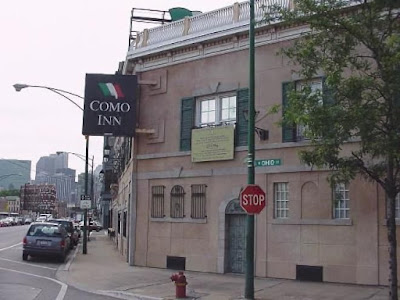 |
| The Como Inn |
The FBI estimates that Chicago now only has 25 "made" members and another 75 organized crime associates. Federal authorities said that 15 years ago the mob had 50 "made" members and as many as 400 associates.
Mob violence has dropped off, as well.
The last known successful mob hit occurred in Nov. 20, 2001. That's when Anthony "Tony the Hatch" Chiaramonti, a top figure in the Outfit's South Side rackets, was gunned down in the vestibule of a west suburban chicken restaurant. The 67-year-old Chiaramonti's murder remains unsolved.
The hit, or rub-out, was used to command loyalty, to take out rivals or to silence witnesses. According to the Chicago Crime Commission, 1,111 gangland slayings have been committed since 1919.
The latest arrests of alleged mobsters generated widespread media interest and calls from overseas talk show hosts who recall the St. Valentine's Day massacre of 1929, which led to the end of Prohibition, made Al Capone a household name and solidified Chicago as the gangster capital of the world. But the Chicago Police Department's definition of organized crime has shifted during recent decades from the Outfit to street gangs like the Latin Kings and the Black Gangster Disciples that control drug sales in the city.
"When you look at who's a bigger threat to the public, it's clear," said Cmdr. Steve Caluris, who runs the Deployment Operations Center, which coordinates all of the department's intelligence gathering. "These aren't just punks hanging out on street corners. It's organized crime." Chicago police statistics show that 1,276 murders were tied to street gangs from 2000 through 2004.
The 41-page racketeering indictment provided fresh insights into the mob's enterprise of illegal gambling, loan sharking and murder. Prosecutors charged that La Cosa Nostra bosses and "made" members were responsible for 18 gangland slayings from 1970 through 1986.
While the Outfit is still active in embezzling from union pension and benefit funds, illegal sports bookmaking, video poker machines and occasional violence, its heyday of influence passed long before Monday's indictments of James Marcello, the reputed boss of the mob; fugitive Joseph "the Clown" Lombardo; and 12 others.
Marcello, Frank Calabrese Sr. and Nicholas Calabrese were the three "made" mob members indicted, according to court records.
"Once `made,' the individual was accorded greater status and respect in the enterprise," the indictment said. "An individual who was `made' or who committed a murder on behalf of the Outfit was obligated to the enterprise for life to perform criminal acts on behalf of the enterprise when called upon."
Prosecutors had begun weakening the Chicago Outfit with a series of successes, though few of the convictions have involved mob murders.
Among the more recent major cases have been that of William Hanhardt, a former Chicago police deputy superintendent, for running a mob-connected jewelry theft ring and reputed Cicero mob boss Michael Spano Sr. for looting $12 million from town coffers.
In the 1990s, convictions included mob leaders Gus Alex, chief political fixer for decades; Lenny Patrick, a gangster for 50 years who became the highest-ranking mobster to turn government informant; Sam Carlisi, former head of the mob's day-to-day operations; Ernest "Rocco" Infelice, convicted of murdering a bookmaker who refused demands to pay "street tax"; and Marco D'Amico, a top gambling boss.
With each aging mobster who dies or goes to prison, the Outfit has not been fully successful in recruiting leadership. Still, law enforcement officials and mob watchers caution that Monday's arrests do not mean the Chicago La Cosa Nostra is near death. La Cosa Nostra--"this thing of ours" or "our thing"--is used to refer to the American mafia.
The mob controls most of the illegal sports betting in the Chicago area, remains stubbornly entrenched in the Teamsters Union and remains disturbingly effective at collecting "street taxes" as a cost to operate businesses such as strip clubs.
While federal authorities, took down alleged members and associates from the Grand Avenue, the 26th Street and Melrose Park crews, the Elmwood Park street crew was untouched. That crew, perhaps the most powerful of the four mob crews in the Chicago area, reputedly is led by John "No Nose" DiFronzo. And even though they are imprisoned, mob bosses have remained adept at running their enterprise from their cells. "They still continue illegal activities through conversations with relatives and associates. It's not going to put them out of business," said James Wagner, a 30-year FBI veteran who retired in 2000.
Court records show that Frank Calabrese Sr., a leader with the mob's 26th Street crew, did just that. Two retired Chicago police officers allegedly delivered messages between Calabrese and mobsters on the outside, including messages to determine whether Calabrese's younger brother, Nicholas, had become an mob turncoat and was cooperating with government. Frank Calabrese Sr. was right to worry; his brother had become an informant, federal authorities said.
The indictment provided sketchy data about a sports bookmaking operation that allegedly was run between 1992 and 2001 by Frank Calabrese Sr. and Nicholas Ferriola. The indictments stated that it operated in northern Illinois and involved five or more people.
Thomas Kirkpatrick, president of the Chicago Crime Commission, said illegal gambling is the mother's milk of the mob.
Kirkpatrick said he had seen one estimate from several years ago that about $100 million was bet with the Chicago mob on the NFL's Super Bowl. "That's where the money is for the mob," Kirkpatrick said. "No one else has the ability to move the money, to cover the bets, to keep the records and to collect debts. That takes an organization."
And, the chairman of the Illinois Gaming Board last week raised concerns that the current board's low staffing of investigators could let organized crime sneak into the state's nine operating riverboat casinos. Gaming officials fear that mob figures would work the casinos in search of desperate gamblers and offer them "juice loans," lending money at rates that can reach 520 percent a year.
The Chicago mob allegedly has its tentacles deep into at least six Teamsters Union locals, according to a report prepared last year by the union's anti-corruption investigators. They turned up allegations of mob influence, kickback schemes and the secret shifting of union jobs to low-wage, non-union companies.
A copy of the report had been provided to the Justice Department after the investigators alleged that union leaders acting at the direction of the Chicago mob had blocked their probe into alleged wrongdoing. "The Chicago area, more than anywhere else where Teamster entities are concentrated, continues to furnish the conditions that historically have made the union vulnerable to organized crime infiltration and systemic corruption: an organized crime family that still has considerable strength, a corrupt business and political environment and resistance to anti-racketeering reform efforts by key Teamster leaders," the report said.
In fact, the FBI's organized crime unit already is investigating some of the allegations in the report.
Agents are looking into whether hundreds of thousands of dollars were siphoned from a Teamsters benefit plan that provides dental care to Chicago-area undertakers and valets, according to sources. "The mob is the same as it always has been," said FBI spokesman Ross Rice, "just on a smaller scale."
Thanks to Todd Lighty and Matt O'Connor.

 , the manager insisted he didn't know any Clown, then checked a fistful of credit card receipts before insisting the fellow was "Irwin Goldman."