The Chicago Syndicate: 04/01/2019 - 05/01/2019

Friday, April 26, 2019

Avengers: Endgame is at the Theaters Today! #FridayFeeling

Avengers: Endgame opens up at theaters todayShop Avengers Endgame Apparel!

After the devastating events of Avengers: Infinity War, the universe is in ruins.

With the help of remaining allies, the Avengers assemble once more in order to undo Thanos' actions and restore order to the universe.

Monday, April 22, 2019

Former Mafia Don Francis Salemme AKA Cadillac Frank is Moved to Prison Medical Facility

Convicted former Mafia don Francis "Cadillac Frank" Salemme has been moved to a prison medical facility because of his advanced age, according to his attorney.

Salemme is listed as 85 years old on the Federal Bureau of Prisons (BOP) website, but his lawyer, Steven Boozang, said the former mob boss is "closer to 88."

Salemme is serving a life sentence after he was found guilty last year of taking part in the 1993 murder of Boston nightclub owner — and Providence native — Steven DiSarro.

Salemme had been held at a federal prison in Brooklyn until his recent move to a medical prison in Springfield, Missouri. The facility is described as an "administrative security federal medical center," on their website.

Boozang said he wasn't sure when authorities moved Salemme, but the BOP's online database showed the octogenarian in Brooklyn as recently as last week.

An email to a prison spokesperson was not immediately returned.

Boozang said at Salemme's age the Brooklyn prison was "a tough place," and the BOP moved him to a facility that can better handle elderly inmates. "Being shot as many times as he had and survived, there are some remnants that catch up with you later in life," Boozang said. "He should be in a medical place being monitored for normal age-related type of conditions."

Salemme was convicted in June along with mob associate Paul Weadick. The two were each charged with murder of a witness. Prosecutors say Salemme was concerned DiSarro would cooperate with investigators in an ongoing probe into a nightclub DiSarro managed. Salemme and his son were silent partners in the club.

Rhode Island mob brothers Robert DeLucca and Joseph DeLuca were key witnesses at the trial at U.S. District Court in Boston.

Salemme has appealed the verdict and Boozang said his client is in "great spirits" and optimistic about his chances.

"Frank is strong and plugging along," Boozang said. "We'll just have to wait and see."

In 1989, Salemme was shot by rival mobsters multiple times outside a Saugus, Massachusetts, pancake house. His survival helped cement his underworld legacy and elevate him to boss. Salemme's tenure ended when he was indicted in 1995.

Thanks to Tim White.

Monday, April 15, 2019

Doing Justice: A Prosecutor's Thoughts on Crime, Punishment, and the Rule of Law

By the one-time federal prosecutor for the Southern District of New York, Doing Justice: A Prosecutor's Thoughts on Crime, Punishment, and the Rule of Law, is an important overview of the way our justice system works, and why the rule of law is essential to our society. Using case histories, personal experiences and his own inviting writing and teaching style, Preet Bharara shows the thought process we need to best achieve truth and justice in our daily lives and within our society.

Preet Bharara has spent much of his life examining our legal system, pushing to make it better, and prosecuting those looking to subvert it. Bharara believes in our system and knows it must be protected, but to do so, we must also acknowledge and allow for flaws in the system and in human nature.
   
The book is divided into four sections: Inquiry, Accusation, Judgment and Punishment. He shows why each step of this process is crucial to the legal system, but he also shows how we all need to think about each stage of the process to achieve truth and justice in our daily lives.
   
Bharara uses anecdotes and case histories from his legal career--the successes as well as the failures--to illustrate the realities of the legal system, and the consequences of taking action (and in some cases, not taking action, which can be just as essential when trying to achieve a just result).
   
Much of what Bharara discusses is inspiring--it gives us hope that rational and objective fact-based thinking, combined with compassion, can truly lead us on a path toward truth and justice. Some of what he writes about will be controversial and cause much discussion. Ultimately, it is a thought-provoking, entertaining book about the need to find the humanity in our legal system--and in our society.

Friday, April 12, 2019

Details on the Julian Assange Computer Hacking #Conspiracy with Chelsea Manning

Julian P. Assange, 47, the founder of WikiLeaks, was arrested in the United Kingdom pursuant to the U.S./UK Extradition Treaty, in connection with a federal charge of conspiracy to commit computer intrusion for agreeing to break a password to a classified U.S. government computer.

According to court documents unsealed, the charge relates to Assange’s alleged role in one of the largest compromises of classified information in the history of the United States.

The indictment alleges that in March 2010, Assange engaged in a conspiracy with Chelsea Manning, a former intelligence analyst in the U.S. Army, to assist Manning in cracking a password stored on U.S. Department of Defense computers connected to the Secret Internet Protocol Network (SIPRNet), a U.S. government network used for classified documents and communications. Manning, who had access to the computers in connection with her duties as an intelligence analyst, was using the computers to download classified records to transmit to WikiLeaks. Cracking the password would have allowed Manning to log on to the computers under a username that did not belong to her. Such a deceptive measure would have made it more difficult for investigators to determine the source of the illegal disclosures.

During the conspiracy, Manning and Assange engaged in real-time discussions regarding Manning’s transmission of classified records to Assange. The discussions also reflect Assange actively encouraging Manning to provide more information. During an exchange, Manning told Assange that “after this upload, that’s all I really have got left.” To which Assange replied, “curious eyes never run dry in my experience.”

Assange is charged with conspiracy to commit computer intrusion and is presumed innocent unless and until proven guilty beyond a reasonable doubt. If convicted, he faces a maximum penalty of five years in prison. Actual sentences for federal crimes are typically less than the maximum penalties. A federal district court judge will determine any sentence after taking into account the U.S. Sentencing Guidelines and other statutory factors.

G. Zachary Terwilliger, U.S. Attorney for the Eastern District of Virginia, John C. Demers, Assistant Attorney General for National Security, and Nancy McNamara, Assistant Director in Charge of the FBI’s Washington Field Office, made the announcement after the charges were unsealed. First Assistant U.S. Attorney Tracy Doherty-McCormick, Assistant U.S. Attorneys Kellen S. Dwyer, Thomas W. Traxler and Gordon D. Kromberg, and Trial Attorneys Matthew R. Walczewski and Nicholas O. Hunter of the Justice Department’s National Security Division are prosecuting the case.

The extradition will be handled by the Department of Justice’s Office of International Affairs.

Thursday, April 11, 2019

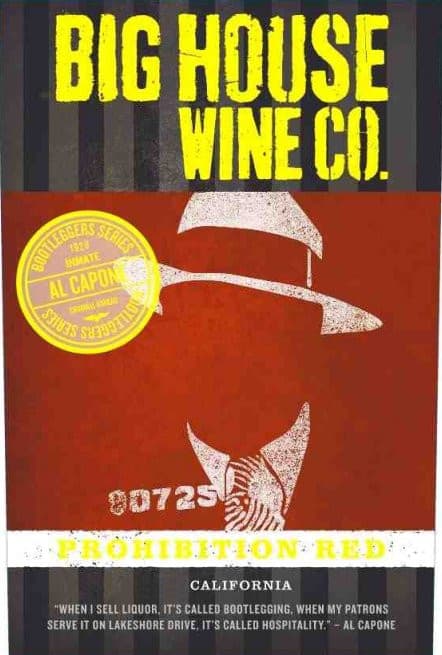
Big House Red Wine Inspired by Al Capone from the Bootlegger's Series

Big House 2016 Prohibition Red Blend - Red Wine.

So dark, so delicious, so dangerous-Big House Prohibition Red showcases notes of blackberries and raspberries, with hints of leather and spices.

The palate is clean, exhibiting flavors of cranberries, roses and a touch of rhubarb. This finish lingers, leaving you with flavors of vanilla and dark cherries.

Prohibition Red walks the line between soft and smooth and powerful and vicious; it’s as infamous as Al Capone himself.

Tuesday, April 09, 2019

Al Capone's Soup Kitchen

Chicago shivered through a particularly bleak November in 1930. As the U.S. economy plummeted into the Great Depression, thousands of the Windy City’s jobless huddled three times a day in a long line snaking away from a newly opened soup kitchen. With cold hands stuffed into overcoat pockets as empty as their stomachs, the needy shuffled toward the big banner that declared “Free Soup Coffee & Doughnuts for the Unemployed.”

The kind-hearted philanthropist who had come to their aid was none other than “Public Enemy Number One,” Al Capone.

Capone certainly made for an unlikely humanitarian. Chicago’s most notorious gangster had built his multi-million-dollar bootlegging, prostitution and gambling operation upon a foundation of extortion, bribes and murders that culminated with the 1929 St. Valentine’s Day Massacre in which he ordered the assassination of seven rivals.

Many Chicagoans, however, had more pressing concerns than organized crime in the year following the Stock Market Crash of 1929. Long lines on American sidewalks had become all-too familiar sights as jittery investors made runs on banks and the unemployed waited for free meals.

In early November 1930, more than 75,000 jobless Chicagoans lined up to register their names. Nearly a third required immediate relief. “The Madison Street hobo type was conspicuously absent from these lines of men,” reported the Chicago Tribune, which noted that many of the unemployed were well-dressed.

A week later the Chicago Tribune reported the surprising news that the mysterious benefactor who had recently rented out a storefront and opened a soup kitchen at 935 South State Street was none other than the city’s king of booze, beer and vice. Capone’s soup kitchen served breakfast, lunch and dinner to an average of 2,200 Chicagoans every day.

“He couldn’t stand it to see those poor devils starving, and nobody else seemed to be doing much, so the big boy decided to do it himself,” a Capone associate told a Chicago newspaper. Inside the soup kitchen, smiling women in white aprons served up coffee and sweet rolls for breakfast, soup and bread for lunch and soup, coffee and bread for dinner. No second helpings were denied. No questions were asked, and no one was asked to prove their need.

On Thanksgiving in 1930, Capone’s soup kitchen served holiday helpings to 5,000 Chicagoans. Reportedly, Capone had planned a traditional Thanksgiving meal for the jobless until he had heard of a local heist of 1,000 turkeys. Although “Scarface” had not been responsible for the theft, he feared he would be blamed for the caper and made a last-minute menu change from turkey and cranberry sauce to beef stew.

The soup kitchen added to Capone’s Robin Hood reputation with a segment of Americans who saw him as a hero for the common man. They pointed to the newspaper reports of the handouts he gave to widows and orphans. When the government deprived them of beer and alcohol during Prohibition, Capone delivered it to them. When the government failed to feed them in their desperate days, the crime boss gave them food. For anyone who felt conflicted about taking charity from a gangster, hunger trumped principles. As the Bismarck Tribune noted, “a hungry man is just as glad to get soup and coffee from Al Capone as from anyone else.”

Writing in Harper’s Magazine, Mary Borden called Capone “an ambidextrous giant who kills with one hand and feeds with the other.” She noted the irony that the line of jobless waiting for a handout from Chicago’s most-wanted man often stretched past the door of the city’s police headquarters, which held the evidence of the violent crimes carried out at Capone’s behest.

Every day, the soup kitchen served 350 loaves of bread, 100 dozen rolls, 50 pounds of sugar and 30 pounds of coffee at a cost of $300. It was a sum that Capone could easily afford since on the same day that news of his soup kitchen broke, Capone bookkeeper Fred Ries testified in court that the profits from Capone’s most lucrative gambling houses cleared $25,000 a month.

Although he was one of the richest men in America, Capone may not have paid a dime for the soup kitchen, relying instead on his criminal tendencies to stockpile his charitable endeavor by extorting and bribing businesses to donate goods. During the 1932 trial of Capone ally Daniel Serritella, it emerged that ducks donated by a chain store for Serritella’s holiday drive ended up instead being served in Capone’s soup kitchen.

Although the press never spotted Capone in the soup kitchen, newspapers ate up the soup kitchen story. Some such as the Daily Independent of Murphysboro, Illinois, expressed displeasure at the adulation bestowed upon its operator. “If anything were needed to make the farce of Gangland complete, it is the Al Capone soup kitchen,” it editorialized. “It would be rather terrifying to see Capone run for mayor of Chicago. We are afraid he would get a tremendous vote. It is even conceivable that he might be elected after a few more stunts like his soup kitchens.”

However, prison, not politics, would be in Capone’s future. No amount of good publicity could save Capone from the judgment of a jury that found him guilty of income-tax evasion in November 1931.

Thanks to Christopher Klein.

Sunday, April 07, 2019

Enjoy an Eliot Ness Amber Lager from @GLBC_Cleveland on #NationalBeerDay

Eliot Ness Amber Lager by the Great Lakes Brewing CompanyEliot Ness Amber Lager is described as an amber lager with rich, fragrant malt flavors balanced by crisp, noble hops.

Per Great Lakes Brewing Co, Eliot Ness Amber Lager was named after one of Cleveland's most respected safety directors who frequented the Brewpub's bar during his tenure from 1935-1941 and, according to popular legend, was responsible for the bullet holes in the bar still evident today. Margaret Conway, the mother of owners Patrick and Daniel Conway, worked with Ness as his stenographer.

Of course, prior to that, he was most widely known for being an American Prohibition agent, famous for his efforts to enforce Prohibition in Chicago, as the leader of a legendary team nicknamed The Untouchables.

Celebrate the Birthday of the Director of the Godfather with Francis Ford Coppola's Director's Cut Red Wine

Celebrate the Birthday of the Director of The Godfather with Francis Ford Coppola 2013 Director's Cut Cinema Red Blend - Red Wine.

Those who are fans of Super Tuscans will enjoy the exotic spice character as well as the juicy fruit impressions of blackberries, cherries, currants, anise and cigar box.

The palate has a soft, elegant entry provided by the Zinfandel, while the mid-palate offers rich, bold flavors of cassis courtesy of our Cabernet Sauvignon.

Lengthy tannins from our Petite Sirah hold everything together for a dramatic finish.


Thursday, April 04, 2019

After Murder of Frank Cali, Who is Boss of the Gambino Crime Family?

Uneasy lies the head that wears a crown.

Following the death of Gambino crime boss Frank (Franky Boy) Cali, experts say his successor will have 21st Century issues to deal with.

“Whoever takes over right now is a media magnet,” said Louis Ferrante, a former mobster with the Gambino family whose crew was investigated at one time for some of the most lucrative heists in U.S. history. “Look, you and I are talking about it ... in today’s world, a lot of (mobsters) don’t wanna be bothered with that."

He said it’s possible that whoever is in line for the promotion taps someone else to be the face, while they continue to pull in money from their rackets and influence the family’s operations from the proverbial shadows.

“If I were the underboss I would probably put someone there as a front for me. I would pick someone who’s in my crew that’s close to me,” said Ferrante.

In the days following Cali’s death, a convicted Genovese mobster and a former Gambino hitman -- both turned-informants -- expressed shock over Cali’s murder considering he was known as a non-violent mob boss who ran his crime family like a corporation, according to a USA TODAY report.

Experts say the “to-do” list for whoever takes over could include dealing with Cali’s suspected killer.

Police said Anthony Comello, 24, of Eltingville, smashed into Cali’s car outside the Hilltop Terrace home, then, shot him while the reputed mobster’s wife and children were inside the house. The motive remains unclear, but every theory at this point indicates Cali was targeted by his killer.

Mob experts and law enforcement sources say it’s unlikely the murder was related to organized crime, based on the fact there was no backup car to potentially finish the job in what would have been an ill-conceived plan. And if months or years from now it turns out it was a planned hit, “It was the most brilliant mob hit in the world," said Ferrante.

Sources have described Comello as a “mob-obsessed” conspiracy theorist, while former classmates have described him as aloof in class, but at times a hot-head who got into fights. A New York Times report quoted friends who claimed he wrestled with drug addiction.

Defense attorney Robert Gottlieb has pointed to right-wing hate speech as playing a factor in the incident, while stopping short of saying his client committed the murder.

One name tossed around by law enforcement experts and Mafia historians as a possible successor to Cali is Lorenzo Mannino, a Gambino capo and member of the family’s Sicilian faction. “Mannino is a Brooklyn crew boss who is Sicilian and was heavy in to drug (trade) with Franky Boy,” said Mafia historian Scott Burnstein.

Other names mentioned include Gene Gotti, the brother of John who recently was released from prison after doing 29 years on drug charges. “If I was a member of organized crime today, Gene Gotti would be the greatest boss I could have,” said Ferrante. “He’s a man of men, within the context of that life.”

Experts say the business of La Cosa Nostra has seen better days.

In terms of the drug-trade, New York City’s streets are now dominated by Dominican gangs paying lower prices to Mexican cartels who are able to ship the drugs by land rather than by sea, said James Hunt, formerly of the Drug Enforcement Administration, who worked as an undercover agent in the famous “Pizza Connection” drug case.

That being said, Cali had deep ties with the Sicilian Mafia, which along with Colombian cartels maintain a profitable heroin trade in Europe, said Hunt, which in turn could be a selling point for Cali’s successor.

Stateside, it can get messy when it comes to drugs, said Ferrante. “If you want to get in to that game, your playing with Asians, Russians, Albanians, Colombians,” he said. “There’s only so many pieces to that pie."

A drug trade still exists for mobsters, but more so on a local level -- unlike the 80s when they’d ship in the drugs from Turkey and Sicily, then sell in bulk to mid-level dealers in Harlem, experts said. And while the days of controlling unions and waste companies are all but over, loansharking and extortion continue to provide a steady stream of income.

“They’ll never stop trying to sneak their way back in,” said Hunt. “It’s harder for them to make a living than they used to, but they’re not going to get jobs.” And where there’s reward, there remains risk.

In the months leading up to Cali’s death, an associate of the Bonanno crime family was gunned down in a McDonald’s parking lot by shooters allegedly hired by an Albanian crime outfit.

Days prior to the murder, a reputed mob enforcer in Rhode Island was shot dead in a case with ties to the Gambino family, according to multiple reports.

Thanks to Kyle Lawson.

Monday, April 01, 2019

Anti-Mafia Writer Roberto Saviano, the Author of Gomorra, Threatened with Jail by Italian Government

Roberto Saviano, the anti-mafia writer and campaigner, faces up to three years in prison after being summoned to stand trial on charges of libelling Italy’s interior minister and deputy prime minister Matteo Salvini.

Saviano – who lives under state protection following mafia death threats – has received a summons to stand trial from prosecutors in Rome following a writ for criminal libel issued last summer by Salvini. In Italy, libel at this level falls under the penal, not civil, code.

Saviano told the Observer: “I face trial for my opinions. It’s a form of extortion by Salvini, making a legal target of his critics. Salvini delivers a clear message to anyone who wants to oppose him or investigate political connections to the Mafia. I am the means by which he can communicate his intentions towards everyone else.” The news brought an outcry from literary and journalistic quarters, led by the French publisher Antoine Gallimard, and novelist Salman Rushdie, who told La Repubblica newspaper: “We writers will always stand by Roberto Saviano. We condemn this shameful attack on his rights, yet again.”

Speaking from Paris, Saviano said: “As yet no trial is fixed – justice in Italy is notoriously slow. But we expect to know the date of an initial hearing soon.”

He said that the charge was not a personal one from Salvini, but official: the writ was submitted on ministry-headed paper “and Salvini has asked to be assisted by state lawyers”. The irony is total: the same ministry has been charged with protecting Saviano with an armed escort while on Italian soil, since he was condemned by the Camorra crime syndicate of Naples for his book Gomorrah: A Personal Journey into the Violent International Empire of Naples' Organized Crime System.

The indictment has its origins in a long-standing duel across cyberspace between Saviano and Salvini, mostly over the latter’s stance on migration; Saviano has repeatedly defended the rights of migrants to land in Italy and supported sanctuary communities and projects, while Salvini has blocked Italian ports to them.

In recent years, Saviano turned to connections between Salvini’s party, La Lega – formerly the Northern League – and Calabrian ‘Ndrangheta mafia syndicates, after the conviction of the league’s former treasurer, Francesco Belsito, for laundering money through the ‘Ndrangheta De Stefano clan, and a miasma of occult and neo-fascist interests. A book was published last month, Il libro nero della Lega – the league’s black book – by Giovanni Tizian and Stefano Vergine, detailing further alleged criminal connections.

In June last year Saviano called Salvini “Il Ministro della Mala Vita” – roughly, minister of the criminal underworld – a phrase deployed in 1910 by anti-fascist intellectual Gaetano Salvemini against the then prime minister Giovanni Giolitti. Salvini responded a month later with the writ, now actioned by prosecutors. He told the Observer: “This indicates an increasing authoritarianism. Salvini is effective prime minister, dangerously converging government and the organisms of state into one.

“The aim is to use the law to neutralise any further opposition, specifically to examine his party’s criminal connections, by menace and fear. The difference between 1910 and now is that then Salvemini was not prosecuted for his opinions, while I’m being taken to trial. The problem is that while Salvini has created consensus, his opponents are fragmented by personal and sectarian divisions.

“Support has been wonderful,” added Saviano, “in France and Mexico, where they have published my articles, Spain, Britain and the US. In Italy it’s much colder – only La Repubblica and other very few intellectuals. Other colleagues have been quieter, partly because they’re tired of me, partly because they’re scared.”

The loudest voices – apart from novelist Erri de Luca – have come from outside Italy: Spanish writers Javier Cercas and Manuel Vilas, Chilean Luis SepĂșlveda, Algerian Kamel Daoud and Americans Erica Jong and Nathan Englander. Other messages have come from British authors Irvine Welsh and Hanif Kureishi, who said: “Freedom of expression no longer exists if a person can be sued for his or her opinions.” The writ, said Kureishi, “deeply offends Italy’s reputation as a European nation of artists, writers and philosophers”. Writers’ institutions have added their condemnation.

Musician John Cale, once of the Velvet Underground, said: “Saviano’s writing is enervating and a moral alert to everyone. The niceties of Italian penal law are too tricky to go into, so I wish him good riddance for the charge.”

Mexican-American Jennifer Clement, president of PEN International, said: “Roberto Saviano has repeatedly risked his life to expose the truth about Italy’s criminal networks… and today he faces up to three years behind bars. Italy should end the use of criminal law in regard to defamation.”

The Committee for the Protection of Journalists issued an alert regarding Saviano’s case, while its programme coordinator for Europe, Gulnoza Said, insisted: “Italy should long ago have scrapped criminal defamation from its books – it has no place in a democracy. We call on Salvini to immediately drop these charges against Roberto Saviano.”

Salvini’s cabinet did not return calls for a statement, but the minister has described his initiative, mysteriously, as “a caress and a lawsuit”. The writ calls Saviano’s posts “detrimental to the honour and reputation of the undersigned and the ministry itself”.

Thanks to Ed Vulliamy.